SARON vs fixed-rate mortgage 2026: rates, margins, risks

The short answer
In autumn 2026, a SARON mortgage is clearly the cheaper option. At the end of August, banks published an average of 1.10% for a SARON mortgage, 1.76% for five years fixed and 2.03% for ten years fixed. Fixing for five years only pays off if SARON rises to an average of more than about 0.66% over that time. If your budget couldn't absorb a rise in rates, fix anyway.
Most pages on this question quote rates without a date, put the margin at "around 1%" and claim SARON was "almost always" cheaper, without showing the sums. We took the figures of the Swiss National Bank (SNB), read the product sheets of three banks and worked out, for a mortgage of CHF 500,000, what the two models would have cost over the last 15 years. The result is less clear-cut than the rule of thumb suggests.
Where the policy rate and SARON stand in October 2026
The SNB policy rate is 0%, and has been since June 2025. At its monetary policy assessment of 24 September 2026, the SNB left it unchanged. Inflation rose from 0.6% in May to 0.8% in August, mainly because oil products became more expensive. For 2026 to 2028, the SNB expects annual average inflation of 0.7% to 0.8%. The sentence behind that forecast is what matters for you: it assumes the policy rate stays at 0% over the whole period. That is a basis for calculation, not a promise. According to the SNB's event schedule, the next assessment is on 10 December 2026.
SARON itself sits slightly below that. It is the rate for Swiss francs lent overnight against collateral, calculated by the exchange operator SIX from trades on the Swiss repo market, as the SIX factsheet on SARON explains. In early October 2026, it stood at −0.04% according to the SNB's official interest rates, as it had on almost every day in September.
What banks charge for new mortgages is collected by the SNB every month as published interest rates for new business. These are the rates banks advertise, as a simple average across all reporting banks. What you actually pay is negotiated with your bank and can differ. For comparing the two models, these figures are still the best public source.
| Mortgage | Average, end of August 2026 | Middle half of banks |
|---|---|---|
| SARON, 3-year framework term | 1.10% | 1.00% to 1.17% |
| 2-year fixed | 1.51% | 1.45% to 1.56% |
| 5-year fixed | 1.76% | 1.69% to 1.80% |
| 10-year fixed | 2.03% | 1.95% to 2.07% |
On a mortgage of CHF 500,000, that means about CHF 5,500 in interest a year with SARON, CHF 8,800 with five years fixed and CHF 10,150 with ten years fixed. Where the 1.10% comes from, even though SARON is below zero, becomes clear once you see how a SARON mortgage is calculated.
How the rate on a SARON mortgage is calculated
Your rate is the SARON of the current quarter, compounded after the fact, plus a margin, and a negative SARON counts as zero. Migros Bank's product information (in German) of 1 January 2026 spells it out: compounded SARON for three months plus a surcharge of 1.100% for owner-occupied homes. If compounded SARON is below 0%, it is taken as 0%.
"Compounded" means the bank compounds the SARON value of every banking day over the interest period, working out a compounded average after the period has run. SIX publishes its own compound rates, calculated in arrears. This leads to a quirk that surprises many borrowers: you only know your rate at the end of the quarter. At Migros Bank, the observation period starts five days before the interest period and ends five days before it closes. The amount of interest due is therefore only fixed five days before the end of the period. Interest is charged quarterly, at the end of March, June, September and December.
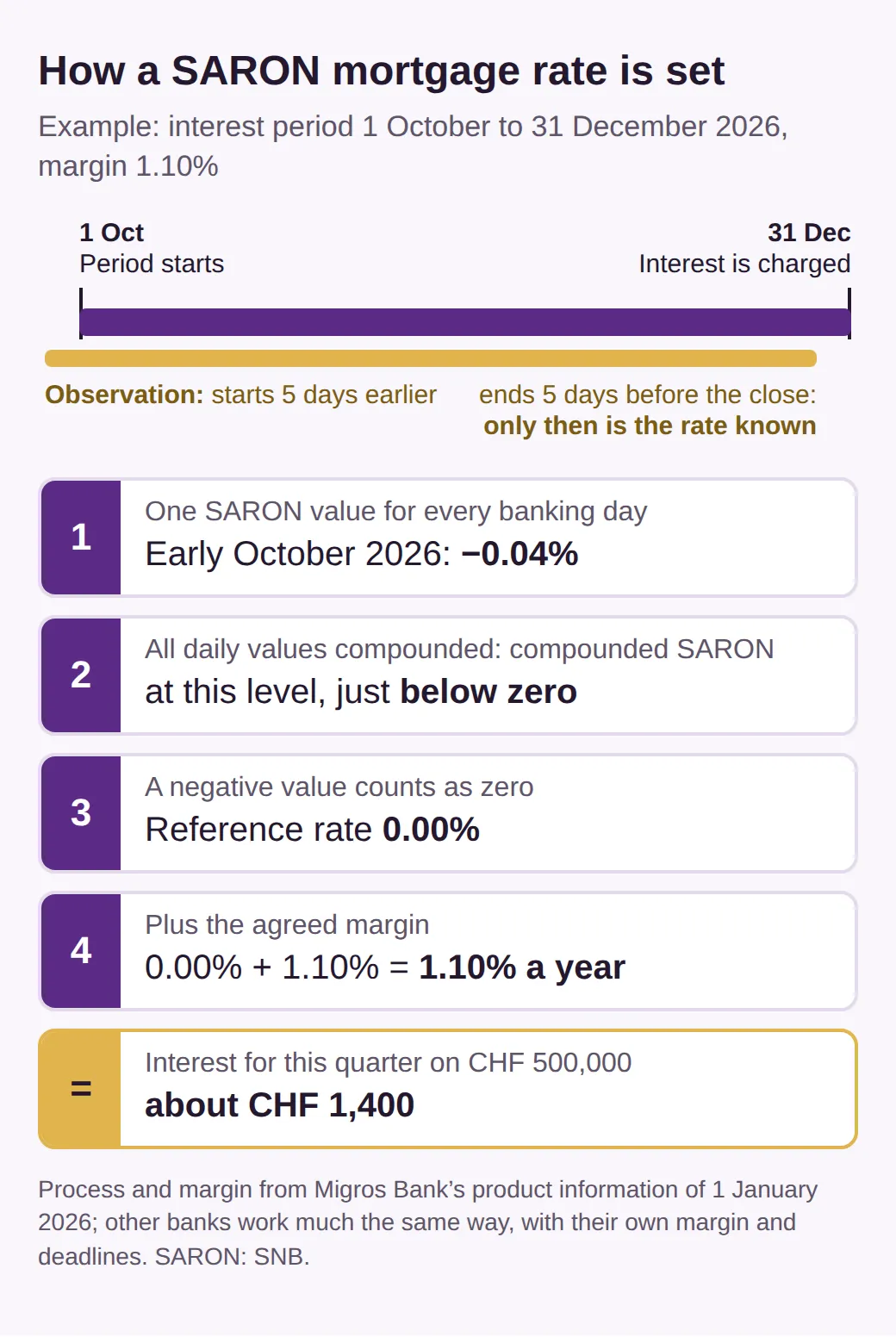
The floor at zero is why a SARON mortgage currently consists of practically nothing but the margin. PostFinance also replaces a negative reference rate with 0.00%. The year 2021 shows how much this can matter: SARON was around −0.72% at the time, yet banks published around 1.00% for SARON mortgages. None of the negative rate reached customers. That still holds: if SARON falls further, your rate won't drop below the margin. If it rises, your rate rises with it, with no cap.
That makes the margin the only part you negotiate. At PostFinance, it explicitly applies for the whole term. Shaving a tenth of a percentage point off the margin saves CHF 500 a year on CHF 500,000, wherever SARON stands. That brings us to the next question: the term of a SARON mortgage.
How flexible a SARON mortgage really is
The rate moves, but the contract doesn't necessarily. Many SARON mortgages run under a framework agreement with a fixed duration, and for that duration you are tied to the bank, much as with a short fixed-rate mortgage.
PostFinance offers its SARON mortgage with a framework term of three years. It lets you switch into a fixed-rate mortgage at the end of a quarter, but only one from PostFinance. Migros Bank offers its SARON mortgage with no fixed term. There you can switch into a Migros Bank fixed-rate mortgage at any time, and repay all or part of it with six months' notice to the end of a month. It charges CHF 400 for closing the loan. Both banks require at least CHF 100,000 per SARON mortgage.
The SNB statistics show a price difference too. A SARON mortgage with a three-year framework term cost 1.10% on average at the end of August, one with no fixed term 1.19%. On average, then, the freedom of having no fixed framework costs a little more.
So check three things in the contract before you sign: how long the framework runs, what notice you have to give, and whether you can only switch into a fixed-rate mortgage with the same bank. If you end a loan with a fixed term early, you owe the bank compensation, as Raiffeisen sets out in a product sheet (in German). A three-year SARON framework is such a loan, so also ask what getting out of it would cost. How that compensation is worked out becomes clear with the fixed-rate mortgage.
What a fixed-rate mortgage costs and what it takes off your hands
With a fixed-rate mortgage, you buy a rate that stays the same for the whole term. At Migros Bank, according to its product information on fixed-rate mortgages (in German), the term runs from a minimum of 2 to a maximum of 10 years. You then know your budget to the franc, whatever the SNB decides.
You can see the price of that in the table above: with five years fixed, you currently pay 0.66 percentage points more than with SARON, and with ten years 0.93 percentage points more. On CHF 500,000, that's CHF 3,300 and CHF 4,650 a year respectively. Think of it as an insurance premium against rising rates.
The second price is the commitment. At Migros Bank, you can't pay back more than agreed during the term. If you want out early, say because you're selling the house, you pay an early repayment penalty. Raiffeisen's product sheet describes how it is calculated: the bank has funded itself for the whole term. If you leave early, it invests your money on the money and capital markets for the remaining term, and you pay the difference between your mortgage rate and that investment rate.
A greatly simplified example, without discounting or fees: you fix CHF 500,000 for ten years at 2.03% and sell after six years. If the bank can only invest the money at 1.0% for the remaining four years, the difference is 1.03 percentage points. That comes to about CHF 5,150 a year, a little over CHF 20,000 for the four years. If rates are higher when you leave than when you signed, the penalty is small or disappears altogether. The risk mainly hits those who fix when rates are high and then have to sell once rates have fallen.
And finally, you give up the benefit of falling rates. Anyone who fixed for ten years in autumn 2022, when the published average was above 3%, pays that rate until 2032, while a new SARON mortgage costs 1.10% in autumn 2026. Whether the extra cost pays off depends on where SARON goes during your term.
At what SARON level does a fixed-rate mortgage pay off?
A fixed-rate mortgage only pays off if SARON averages more over your term than the current rate gap between the two models. For five years fixed, that threshold is about 0.66%; for ten years, about 0.93%. What counts is the average over the whole term, not the peak.
An example makes this concrete. If SARON stays at zero for two years and then rises to 1.0%, it averages 0.6% over five years. SARON would then have been slightly cheaper, even though rates went up. If it rises to 1.0% after just one year, the average is 0.8%, and the five-year fixed-rate mortgage would have paid off. For an average above the threshold, the SNB would have to raise its policy rate soon and noticeably. Its September 2026 forecast is based on a policy rate of 0% until 2028, but an assumption is not a commitment.
More important than the odds is what your budget can take. The last rise in rates shows how fast things can move. In autumn 2023, the monthly average of SARON was around 1.7%. If that level came back, a SARON mortgage with a 1.10% margin would cost 2.8%, which on CHF 500,000 means CHF 14,000 in interest a year instead of CHF 5,500. That's a good CHF 700 more a month. If you could pay that from your income or a reserve without getting into difficulty, SARON is a defensible choice. If not, the fixed-rate mortgage is the more honest answer, even if it costs more on average.
Whether you can afford the house at all is something the bank tests anyway, not with your contract rate but with an imputed rate, 5% at PostFinance; we show how the calculation works in our article on affordability. A cheap SARON mortgage doesn't make an overpriced house affordable. And from 2029 there's a tax question as well: with the abolition of the imputed rental value, the deduction for mortgage interest on an owner-occupied home is abolished. Only first-time buyers may still deduct a falling maximum amount for ten years. After that, every franc of interest costs you in full, including every extra franc the more expensive model costs.
2022 to 2024: when SARON cost more than a fixed rate
The rule of thumb that SARON is cheaper hasn't always held in recent years. From the end of 2023 to the end of 2024, a SARON mortgage cost more than a five- or ten-year fixed-rate mortgage in most months. The SNB statistics show this clearly.
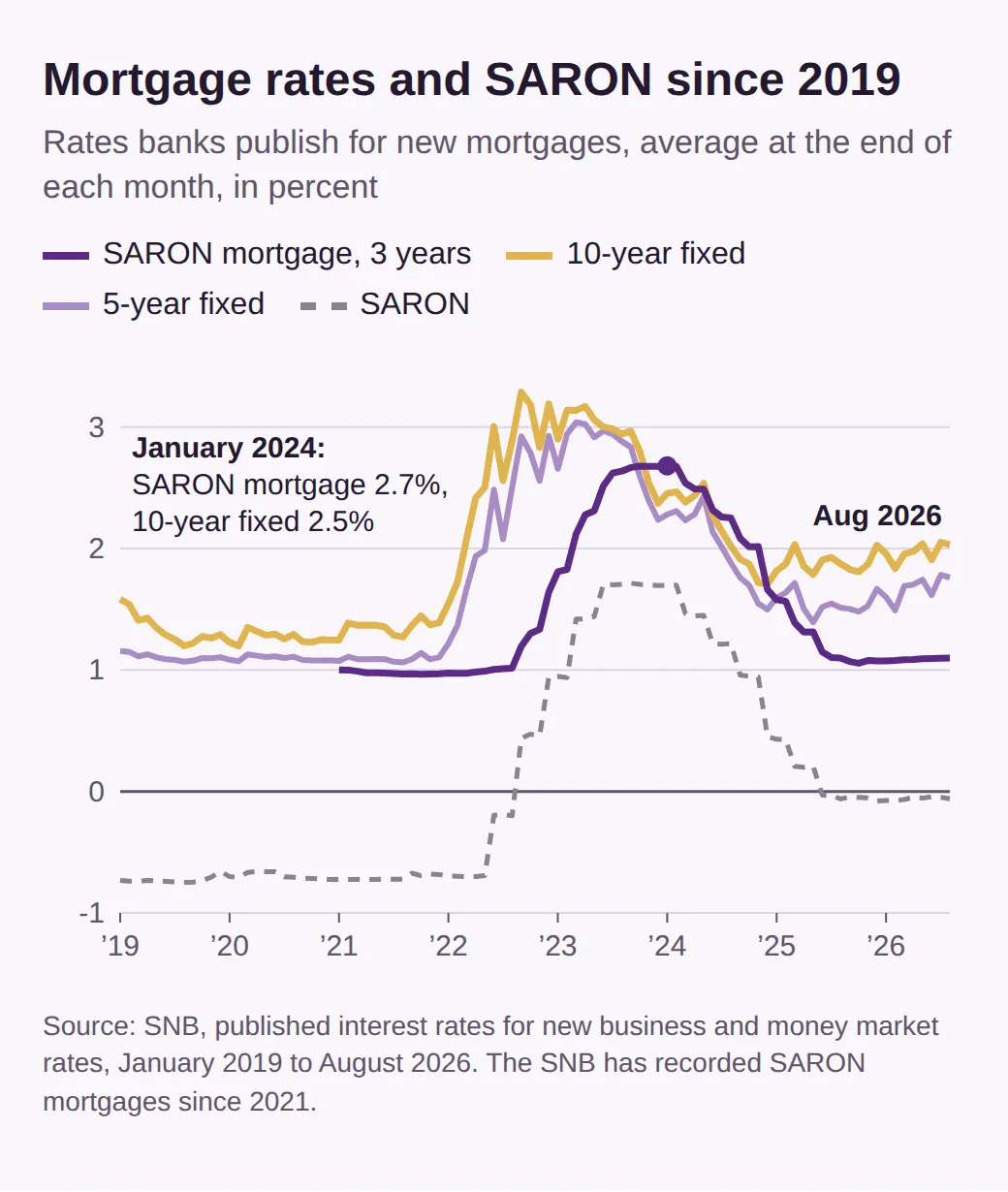
Fixed rates began rising in early 2022, months before the SNB's first rate hike. The ten-year fixed rate jumped from about 1.5% in January to over 3% in September 2022. The SARON mortgage stayed at 1% until mid-2022, because SARON was still negative and the floor applied. Then the SNB raised its policy rate in five steps between June 2022 and June 2023, from −0.75% to 1.75%, and the SARON mortgage followed.
In January 2024, banks published an average of 2.68% for a SARON mortgage, 2.28% for five years fixed and 2.45% for ten years fixed. Anyone who went for SARON then was paying more than with a long fixed-rate mortgage. They were betting that the SNB would cut rates again, and it did: from March 2024 it cut in six steps, down to 0% in June 2025. Fixed rates had already priced in part of those cuts. They fell earlier than the SARON mortgage, but not as far.
Since early 2025, the picture has been the familiar one again. The gap isn't fixed, though: because the ten-year fixed rate has risen from 1.81% to 2.03% since October 2025 while the SARON mortgage barely moved, fixed-rate mortgages have become relatively more expensive. Only the long look back shows how things played out over whole terms.
What 15 years of interest rate history show
If you chose a five-year term between 2010 and 2018, SARON came out ahead every time. If you chose in 2019, 2020 or 2021, the fixed-rate mortgage served you better. That's what you get when you run the SNB figures for each start year.
Our calculation is kept simple. For the SARON option, we take the monthly average of the daily SARON values, at least 0%, and add a margin of 1.0%. That's roughly what banks published in 2021, when SARON was negative. For the fixed-rate mortgage, we take the average published five-year rate in January of the start year and hold it for five years. The SNB has only recorded SARON mortgages since 2021; for the years before that, the calculation shows what a money market mortgage with a floor and a margin like those of 2021 would have cost.
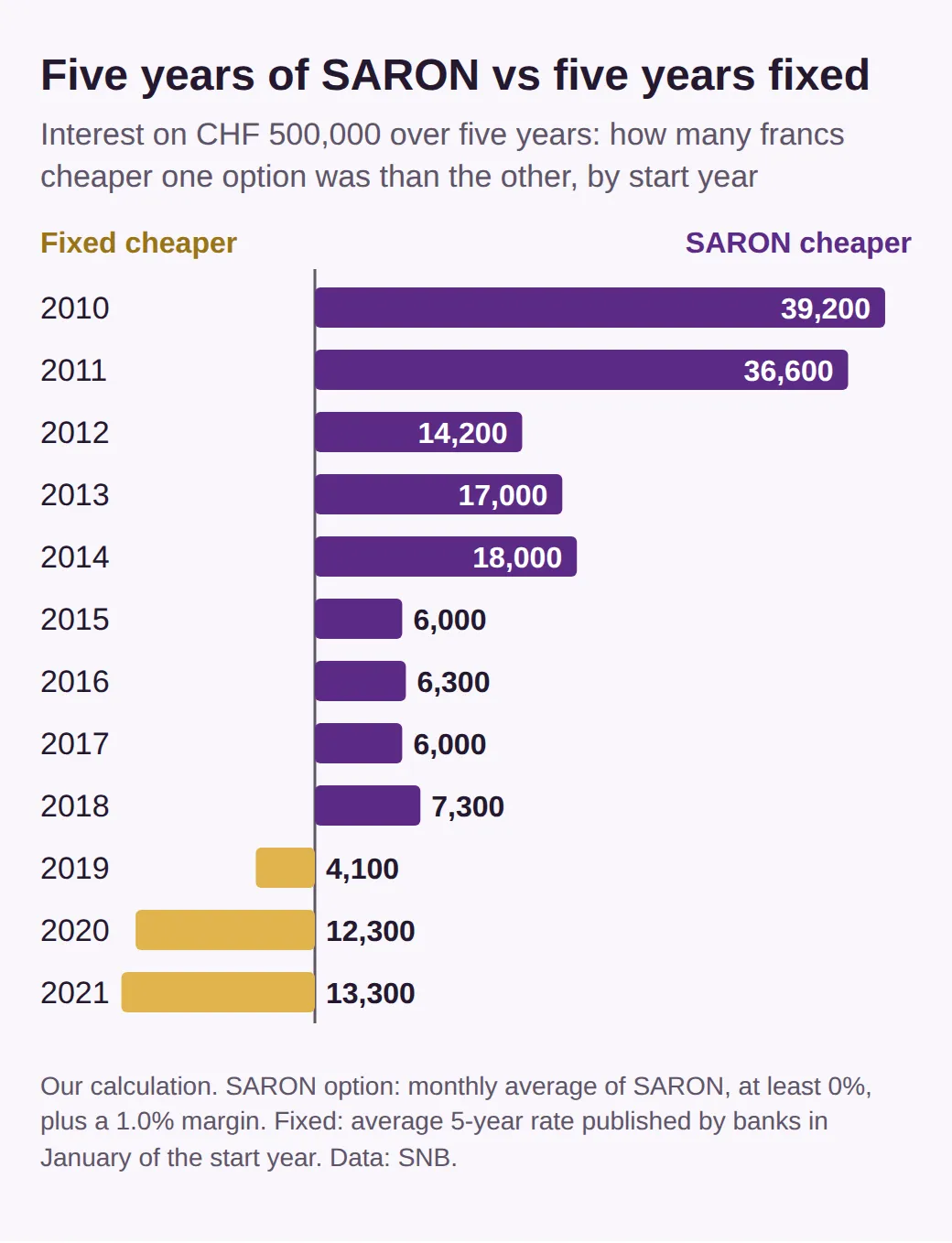
SARON's big wins date from 2010 and 2011, when five years fixed still cost around 2.5% and SARON was around zero. From 2015, its lead shrank to about CHF 6,000 over five years, a little over CHF 1,000 a year. And anyone who got a five-year fixed rate of 1.07% at the start of 2021 saved CHF 13,300 compared with SARON, because the rise in rates came in the middle of their term. Over ten years, with start years from 2010 to 2016, SARON was cheaper every time in our calculation.
The lesson isn't that one model wins as a rule. SARON wins when the fixed rate at signing is well above the later SARON average. The smaller the gap at signing, the more easily the sums tip. In our calculation, it was below 0.2 percentage points from 2019 to 2021, and the 2022 rise in rates alone was enough for the fixed-rate mortgage to win. In autumn 2026, at 0.66 percentage points, it's about as wide as from 2012 to 2014. Back then SARON won clearly, because SARON stayed at zero for years afterwards.
Mixing and staggering
You don't have to commit to one model. A mortgage can be split into several tranches, each with its own model and term; PostFinance explicitly mentions combining SARON and fixed-rate mortgages. In its product sheets, Migros Bank itself recommends a mix of SARON and fixed-rate mortgages, or staggered terms, to reduce the risk of sharply rising rates.
An example with CHF 600,000: CHF 300,000 as a SARON mortgage and CHF 300,000 fixed for eight years. If rates rise, only half is affected. If they fall, half benefits. If several fixed tranches expire at different times, you never have to renew the whole mortgage at once at a bad rate.
There are two catches. Banks require a minimum amount per mortgage. At Migros Bank, it's CHF 100,000 for each SARON and each fixed-rate mortgage, and PostFinance also requires CHF 100,000 for a SARON mortgage. Below CHF 200,000, a Migros Bank mortgage can't be split into two tranches at all. And tranches with different end dates tie you more closely to your bank, because they never all come up for renewal at the same time. How large a mortgage you need in the first place depends on how much equity you bring; we explain that in our article on equity.
What to do now
Get at least three offers. For SARON, compare the margin and the framework term; for a fixed-rate mortgage, compare the rate for two or three different terms. Then compare the offers with the SNB averages: a SARON rate above 1.17% or a ten-year rate above 2.07% put a bank in the most expensive quarter at the end of August.
Next, run your own stress test. Take SARON's autumn 2023 level of around 1.7%, add your margin and multiply by your mortgage. If you could pay that rate for a few years, there's a lot to be said for SARON or a mix. If you need certainty, for example because your budget is tight or your children are still in education, fix part or all of it.
And plan your exit from the start. If you might move within five years, don't fix for ten. If you choose SARON, find out whether you can switch into a fixed-rate mortgage and on what date. And put 10 December 2026 in your diary: that's when the SNB next decides on its policy rate, and you'll see whether the 0% assumption still holds.
Common questions
Do Swiss banks still offer variable-rate mortgages?
Yes, and the SNB still tracks them in its statistics. At the end of August 2026, banks published an average of 2.79% for them, well above a SARON mortgage or a ten-year fixed-rate mortgage. At that price, it is rarely the cheap choice for a purchase.
Can I lock in a fixed mortgage rate before I buy?
Yes, with what is called a forward mortgage. Migros Bank, for example, fixes the rate up to 24 months in advance, and the first six months of that are free. For a longer lead time, ask about the surcharge before you sign.
Do fixed mortgage rates follow the SNB policy rate?
Not directly. The bank funds a fixed-rate mortgage for the whole agreed term, so its price follows long-term interest rates. That is why the average published ten-year rate rose from 1.81% in October 2025 to 2.03% in August 2026, even though the policy rate stayed at 0% the whole time.
Can I make extra repayments on a fixed-rate mortgage?
Usually not without a cost. Migros Bank explicitly rules out paying back more than agreed during the term; at the end of the term you can repay without notice. With its SARON mortgage, a partial repayment is possible with six months' notice to the end of a month.
More from the blog
All posts
Property transfer tax in Switzerland by canton: 2026 costs
Property transfer tax, notary and land registry fees in Zurich, Bern, Vaud and Aargau: the legal rates, who pays and what a CHF 1m apartment costs.

Reservation agreement in Switzerland: is your deposit lost?
Without a notary, a Swiss property reservation agreement is void. What the top court ruled on deposits, how to pay safely and the steps to the land register.

Buying a house in Switzerland as a foreigner: 2026 rules
Who can buy property without authorisation: EU/EFTA, B, C, L and G permits, non-EU buyers, holiday homes, land, moving away and the planned Lex Koller reform.