Equity to buy a house in Switzerland 2026: rules and costs

The short answer
For a home you live in yourself, banks usually ask for 20 percent equity. At least 10 percent of the value the bank puts on the property must come from money outside your pension fund: savings, pillar 3a, gifts, advances on an inheritance. You can withdraw or pledge the rest from your pension fund. The other costs of buying come on top.
Most guides stop there. The expensive part is in the details: when the bank values the house below the purchase price, when the withdrawal triggers a tax that varies more than fourfold depending on where you live, or when money from your parents turns up again when the estate is divided. We go through the sources of equity one by one, in the order a bank checks them. We draw on the rules of the Swiss Bankers Association, federal pension law and the tax calculator of the Federal Tax Administration (FTA).
Where the 20 and the 10 percent come from
Only the 10 percent is binding. The Guidelines on minimum requirements for mortgage loans of the Swiss Bankers Association (SBA), published in German only, require 10 percent of the lending value to come from money outside the second pillar, neither withdrawn from it nor pledged. These are the banks' own rules, but the Swiss Financial Market Supervisory Authority FINMA recognises them as a minimum standard, and a bank that does not follow them has to back the loan with more of its own capital. The current version has been in force since 1 January 2025.
The 20 percent, on the other hand, is practice, not law. UBS writes, for example, that people buying a home in Switzerland "usually have to finance 20% of the market value of the property through equity capital", with a mortgage covering the rest. For a holiday home, the same bank generally asks for 40 percent.
The word that matters is lending value. It is the value the bank gives the house, and it can be lower than the purchase price. For that case the SBA rules contain a second sentence that many people overlook: you must pay the difference between a higher purchase price and a lower lending value entirely from your own money, and none of it may come from the second pillar.
A worked example shows what that means. You buy a house for CHF 900,000 and the bank values it at 860,000. It lends at most 80 percent of that, so CHF 688,000. That leaves CHF 212,000 to find, and at least 126,000 of it must be hard money: 10 percent of the valuation plus the gap of 40,000. From your pension fund you can put in at most CHF 86,000.
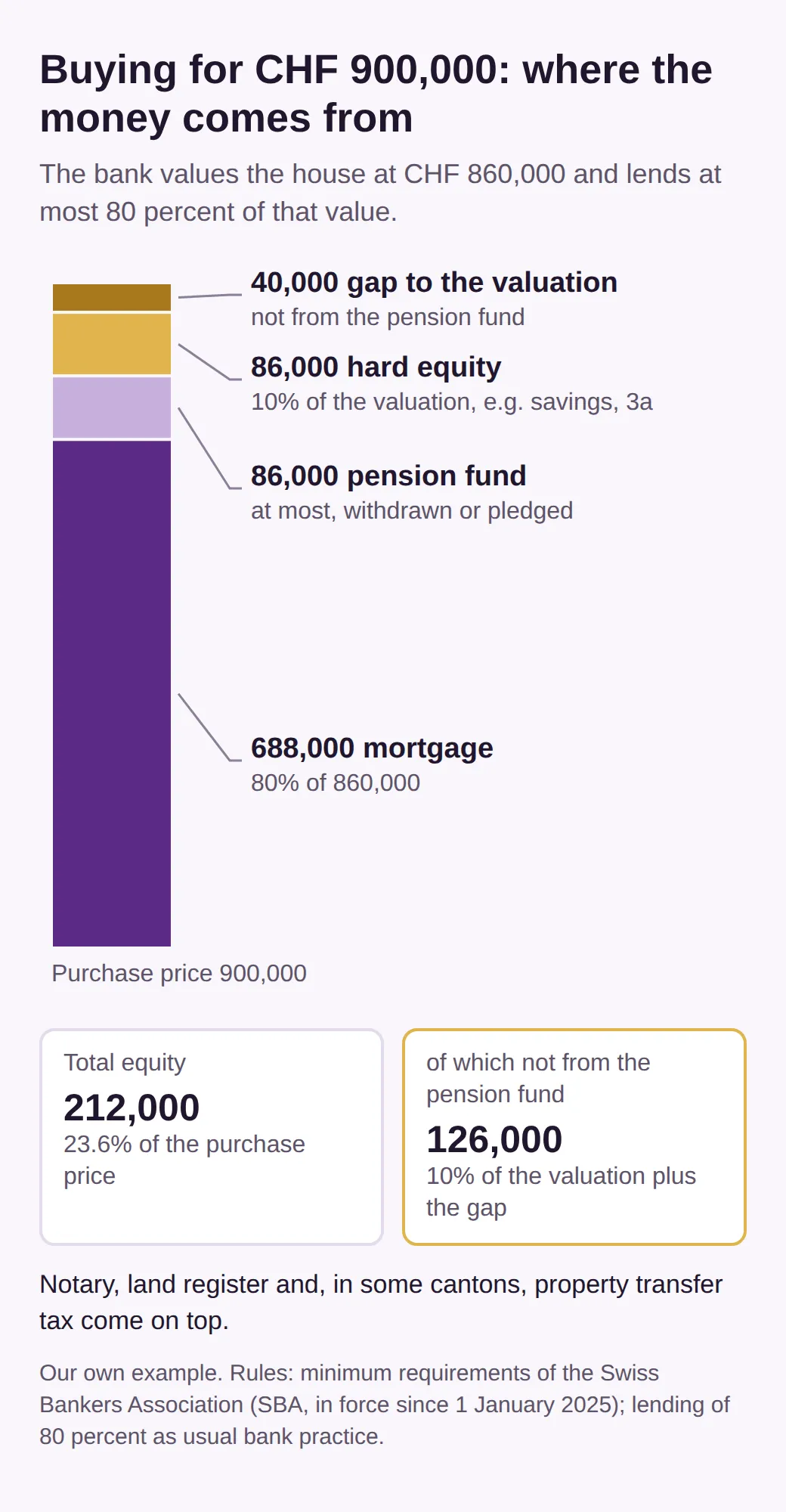
Had the bank valued the house at CHF 900,000, you would need CHF 180,000 of equity for the same purchase, 90,000 of it hard. So the lower valuation costs you CHF 32,000 more equity and 36,000 more hard money. That is why you should have your bank value the house before you sign the purchase contract. A second rule already concerns the years after the purchase: within 15 years the mortgage must come down to two thirds of the lending value, in the example to around CHF 573,000. Whether your income can carry that is a separate calculation. The first question is what the bank counts as hard money.
What counts as hard equity?
Hard equity is anything that does not come from the second pillar. The SBA guidelines expressly include advances on an inheritance and gifts, pledged account balances and securities, pillar 3a savings and the surrender value of insurance policies. A loan counts as your own money too if it is assigned to the bank or comes with a subordination agreement that ranks it behind the mortgage.
For a home you live in yourself, there is a simpler route for loans from the family. If your spouse or partner, parents, grandparents, siblings or adult children and grandchildren lend you money, the bank may count it as your own money once the lender confirms to the bank in writing that you will repay the loan only with the bank's consent. Ask your bank whether it has a form for this. In substance, it comes down to a sentence like this one:
I confirm to the bank that the loan of CHF 60,000 I have granted my daughter to buy her home may only be repaid with the bank's consent.
Money in the second pillar, on the other hand, never counts as hard, and that includes a vested benefits account, for example one left over from a gap between two jobs. The federal act on occupational pensions (BVG; like the other pension and tax laws we link here, it has no English version) treats such accounts like a pension fund when it comes to home ownership. You can use the money for the house, but only within the share that is open to the pension fund. How best to use that share is the next question.
Pension fund: withdraw or pledge?
You have two routes, and the bank counts both the same. With a withdrawal, the pension fund pays out money, your pension goes down and you pay tax straight away. With a pledge, the money stays in the fund, the bank holds it as security and lends you more in return. Your mortgage is then higher, but your pension stays untouched as long as the bank does not have to realise the pledge.
The withdrawal
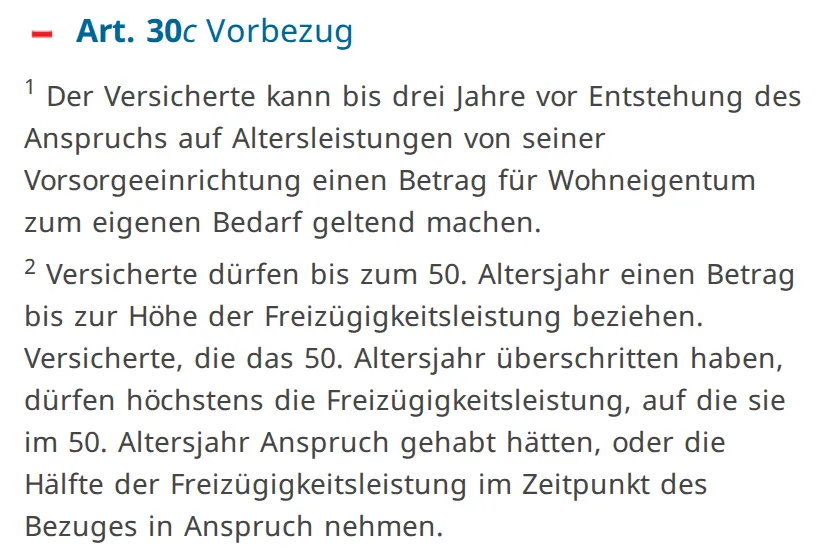
How much you can withdraw depends on your age. Up to 50 it is your entire vested benefit, the balance you would take with you if you left the fund. After that, it is at most what you had at 50 or half of today's balance, whichever is higher. The last possible date is three years before you become entitled to retirement benefits; your fund's rules set which date that is.
The ordinance on home ownership promotion sets further limits. A withdrawal must be at least CHF 20,000, except from a vested benefits account, and you can make one only every five years. The money can go into only one property at a time, and you must live in it yourself at your place of residence. If you are married or in a registered partnership, you need your partner's written consent.
Allow plenty of time. The fund has to pay out no later than six months after you request the withdrawal, and it does not pay you but the seller or whoever you owe the money to. If you only think of it after signing at the notary, things can get tight. When it pays out, the fund has a restriction on sale noted in the land register.
The withdrawal has a price that comes later. Your retirement benefits go down, and depending on your fund's rules, so do the benefits on death and disability. The fund must offer or arrange additional insurance, but you pay the premium. And as long as the withdrawal has not been repaid, voluntary buy-ins into the pension fund are blocked. If you were planning to cut your taxes with buy-ins, you lose that option for years.
If you sell the house, you must repay the withdrawal, but no more than the proceeds, meaning the sale price minus the mortgages and the charges the law places on the seller. If you buy another home within two years, you can park the money in a vested benefits account until then. You can repay voluntarily at any time up to retirement, in amounts of at least CHF 10,000.
The pledge
With a pledge, no money changes hands. You pledge your entitlement to pension benefits, or an amount up to your balance, to the bank, and in return the bank lends you what you would otherwise have withdrawn. The same age limits apply as for a withdrawal, the fund must be told in writing, and here too you need your spouse's consent, as Art. 331d of the Code of Obligations sets out.
The advantage: your pension stays intact and you pay no tax now. Only if the bank has to realise the pledge, for instance because you can no longer pay the mortgage, are the proceeds taxed like a withdrawal. The drawback is the larger mortgage. In the example above it would be CHF 774,000 instead of 688,000, and every percentage point of interest on the extra CHF 86,000 costs CHF 860 a year.
Until now that interest was tax-deductible, which made pledging attractive. That is changing: with the abolition of the imputed rental value from 2029, the interest deduction for a home you live in yourself is abolished, except for first-time buyers, who keep a capped deduction for ten years that shrinks over time. So if you pledge today, expect to deduct the interest on the extra amount only in part, or not at all, from 2029. You face the same choice with pillar 3a.
Pillar 3a: withdraw or pledge
Your 3a savings count as hard equity, because the SBA rules exclude only the second pillar. You can withdraw them for your home or pledge them.
The ordinance on pillar 3a (BVV 3) governs the withdrawal much like the pension fund rules. It is allowed for buying or building a home and for paying off a mortgage, once every five years, only for a home you live in yourself and with your spouse's written consent. Unlike with the pension fund, though, the ordinance makes no provision for paying the money back. Whatever you withdraw has left your retirement savings for good.
Pledging is possible here too and follows the same rules as for the pension fund. A pledged 3a account can also serve later for indirect amortisation: instead of paying down the mortgage directly, you pay into pillar 3a and pledge the account to the bank. The SBA guidelines expressly allow this. Whether you withdraw or pledge therefore often comes down to tax.
How much tax do you pay on a pension withdrawal?
A withdrawal from a pension fund or pillar 3a is a capital benefit from pension provision. It is taxed separately from your other income: by the Confederation at one fifth of the normal rate, by the canton and municipality at their own rates. What it costs depends almost entirely on where you live.
We ran a withdrawal of CHF 100,000 for tax year 2026 through the FTA tax calculator, for a single person without church tax, in all 26 cantonal capitals. Federal tax is CHF 537 everywhere. With cantonal and municipal tax added, you pay CHF 1,926 in Schwyz, 4,817 in Zurich and 7,937 in Herisau.
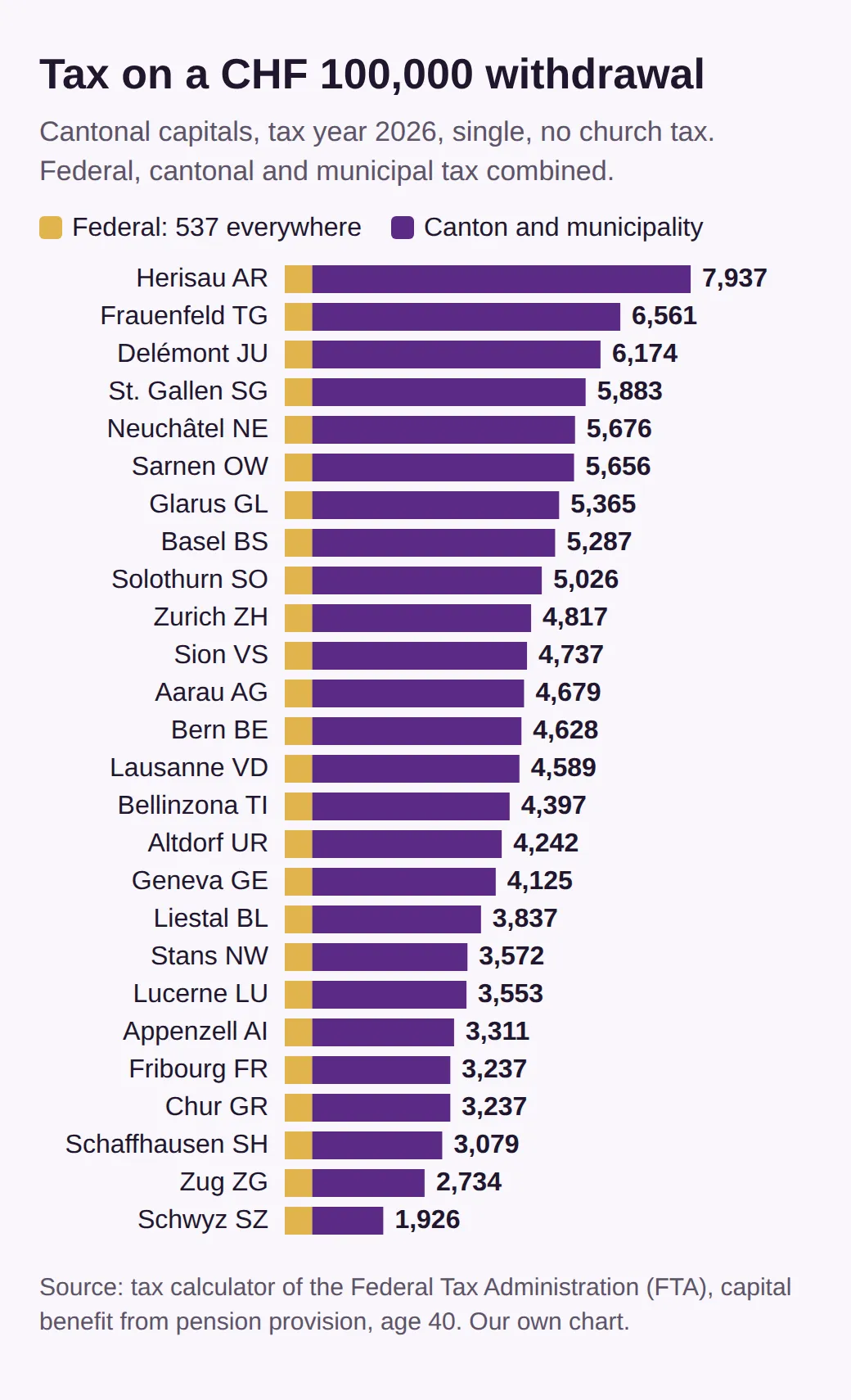
For married couples it is somewhat less in all 26 capitals; how much less depends heavily on the canton. In Bern the tax on the same amount drops from CHF 4,628 to 3,801, in Zurich only from 4,817 to 4,643. And the tax rises faster than the amount. In Zurich, a withdrawal of CHF 50,000 costs CHF 2,220 in tax and one of 200,000 already costs 11,141, more than twice as much as for 100,000. At federal level alone, the tax rises from CHF 537 to 2,581 between a withdrawal of 100,000 and one of 200,000. If you do not need your whole balance, it pays to withdraw only as much as the bank requires.
One risk of higher rates is off the table, at least for now. With the 2027 relief package (page in German), the Federal Council wanted to tax capital withdrawals from the second and third pillars more heavily. Parliament struck that measure out and passed the package without it on 20 March 2026.
The tax on a withdrawal is not lost, by the way. If you later repay the withdrawal to the pension fund, the state refunds the tax you paid, though without interest. You must claim it in writing within three years of the repayment, from the authority that levied the tax, as Art. 83a BVG provides. In return, you cannot deduct the repayment itself from your income. With pillar 3a there is no such way back. Money from your parents, on the other hand, usually stays tax-free.
Advance on inheritance or gift from your parents
For the bank both are equally good: advances on an inheritance and gifts count as hard equity. For your family, though, the difference is big, and it should be on paper before any money changes hands.
What parents give their children during their lifetime to set them up or as a transfer of assets has to be accounted for among the siblings when the estate is divided, unless the parents expressly say otherwise. That is the rule in Art. 626 of the Civil Code. An advance on your inheritance for the house will therefore be counted against your share later. If that should not happen, your parents must state it clearly. If they only want to lend you the money, the family loan with the confirmation to the bank is the right route.
On tax, children usually do well. According to the FTA tax calculator, a gift of CHF 100,000 to a child in 2026 costs nothing in 25 of the 26 cantonal capitals. The exception is Neuchâtel, at CHF 3,000. What counts is the canton where the person making the gift lives.
For unmarried couples it is a different story. If one partner brings in more money and gives the other part of it, the same gift of CHF 100,000 costs nothing in Lucerne or Schwyz, CHF 7,200 in Zurich and 47,879 in Geneva. The 7,200 in Zurich applies only if the couple has lived together for at least five years; before that it costs more. Other cantons also tax partners at a lower rate only after a minimum period like this. A loan between partners is not a gift, and the SBA rules expressly count partners among the close family whose loans the bank recognises. For many couples that is the cheaper route.
Before you sign the purchase contract
You save the most money by putting your equity together before you commit to a house. Ask your pension fund in writing for the information it must give you under the ordinance: how much you can use, how much your benefits will fall, how you can insure the gap on death and disability, and what tax is due. With those figures you can see whether a withdrawal or a pledge works out cheaper for you.
Put any money from your family in writing, as an advance on your inheritance, a gift or a loan, and get your spouse's consent for the withdrawal early. Have your bank value the house before you sign, so you spot any gap to the purchase price in time. And set money aside separately for the notary, the land register and any property transfer tax, because those costs do not count towards your equity. Once the figures are in place, you can find current houses and apartments from all over Switzerland on our home page.
Common questions
Can I use my pension fund to buy a holiday home in Switzerland?
No. The law allows withdrawals and pledges only for a home you live in yourself where you are domiciled or habitually resident, and only for one property at a time. The same goes for pillar 3a. You have to finance a holiday home with other money, and banks usually ask for considerably more equity for it.
What happens to a pension withdrawal for a home if you divorce?
If the marriage ends in divorce before retirement or another insured event, the withdrawal counts as part of your vested benefits and is split along with them. The money may be tied up in the house, but it still counts when the pension assets are divided. Whoever keeps the house has to factor that into the settlement.
Can I rent out my home if I bought it with pension fund money?
Only temporarily, and only if you can show that you cannot live in it yourself during that time, for example because of a fixed-term job elsewhere. A sale, or granting a right that amounts economically to a sale, triggers the obligation to repay the withdrawal.
Does a vested benefits account count as hard equity?
No. A vested benefits account belongs to the second pillar, even if you are not in a pension fund at the moment. You can withdraw or pledge it for your home, but the bank counts it towards the pension fund share, not towards the 10 percent of hard money.
More from the blog
All posts
Property transfer tax in Switzerland by canton: 2026 costs
Property transfer tax, notary and land registry fees in Zurich, Bern, Vaud and Aargau: the legal rates, who pays and what a CHF 1m apartment costs.

Reservation agreement in Switzerland: is your deposit lost?
Without a notary, a Swiss property reservation agreement is void. What the top court ruled on deposits, how to pay safely and the steps to the land register.

Buying a house in Switzerland as a foreigner: 2026 rules
Who can buy property without authorisation: EU/EFTA, B, C, L and G permits, non-EU buyers, holiday homes, land, moving away and the planned Lex Koller reform.