Reservation agreement in Switzerland: is your deposit lost?

Before you sign
In Switzerland, a reservation agreement for a house or an apartment binds nobody until a notary has put it into a public deed: without that, it is void. As a rule, you therefore get a deposit back, even if the agreement says you forfeit it. At most, the seller may keep costs they can prove. The bigger risk is where you send the money.
The Federal Supreme Court has settled the law several times. Buyers still lose money on reservations, and mostly not in court but because the recipient has long since spent it. Seven judgments show where the line runs and when the money is gone all the same.
Why a reservation agreement without a notary is void
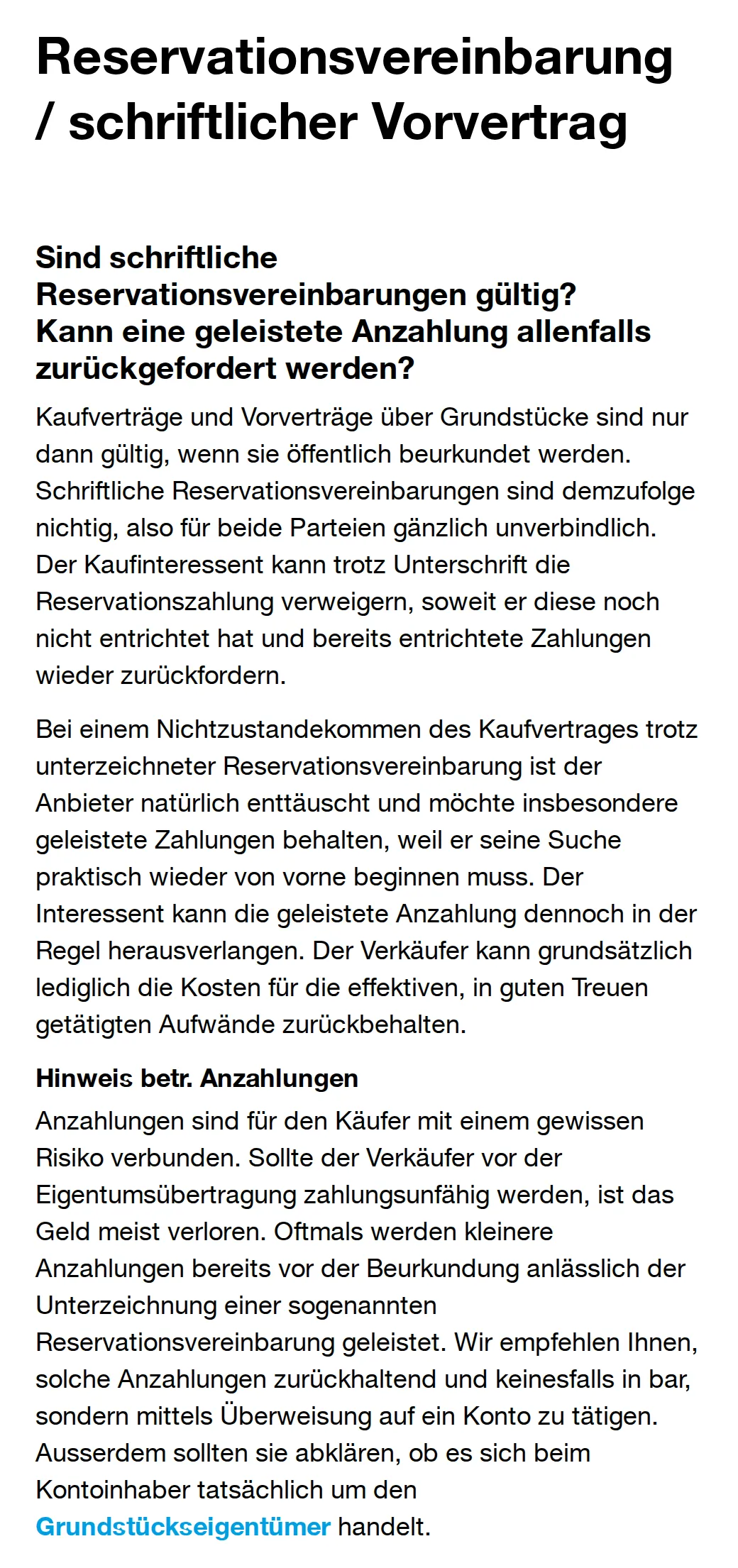
A contract to buy land is valid only if it is made as a public deed, and the same applies to any preliminary contract. That is what Art. 216 CO says: paragraph 1 covers the purchase contract, paragraph 2 preliminary contracts as well as rights of purchase, pre-emption and repurchase. A condominium apartment is covered just the same, because under Art. 655 CC a co-ownership share also counts as immovable property.
A reservation agreement is such a preliminary contract. The seller promises to keep the property for you, and you promise to buy it. Without a public deed, the agreement is void under Art. 20 CO, as the Federal Supreme Court confirms in judgment 4A_109/2018, among others. Void means the agreement never applied, for either side. You do not have to buy, and the seller may let someone else have the house.
Hardly anyone puts it as plainly as the authority that itself draws up public deeds in the canton of Zurich. On their page on reservation agreements (in German), the notaries' offices write that you can refuse the payment despite your signature and claim back anything you have paid.
Why so strict? The public deed is meant to protect both sides from rushed decisions, to make sure they get expert advice and to give the land register a reliable basis. That is how the Federal Supreme Court sums up its purpose in BGE 140 III 200.
A second rule follows from this, and it often gets lost with reservations: everything that concerns the price and what is given in return must go into the deed. In May 2025, judgment 4A_53/2025 dealt with a property sold for CHF 4 million. The buyer had earlier lent the seller money and claimed back CHF 335,000 including the agreed interest. The seller argued that a reservation agreement had settled that the debt would be waived because he was selling at a lower price. The Federal Supreme Court held that such an arrangement would be invalid without a public deed, even if the buyer had signed it. So whatever matters to you about the price belongs in the notarised purchase contract, not in the reservation. But what happens to money that has already changed hands?
What the Federal Supreme Court has ruled on deposits
Anyone who received a deposit under a void reservation agreement must pay it back, and a clause saying it is forfeited if you pull out is void along with the agreement. In legal terms this is unjust enrichment: whoever received something for a reason that never came about must return it (Art. 62 para. 2 CO). Three cases show how this played out in practice.
Thurgau 2004: the building plot near the pig farm
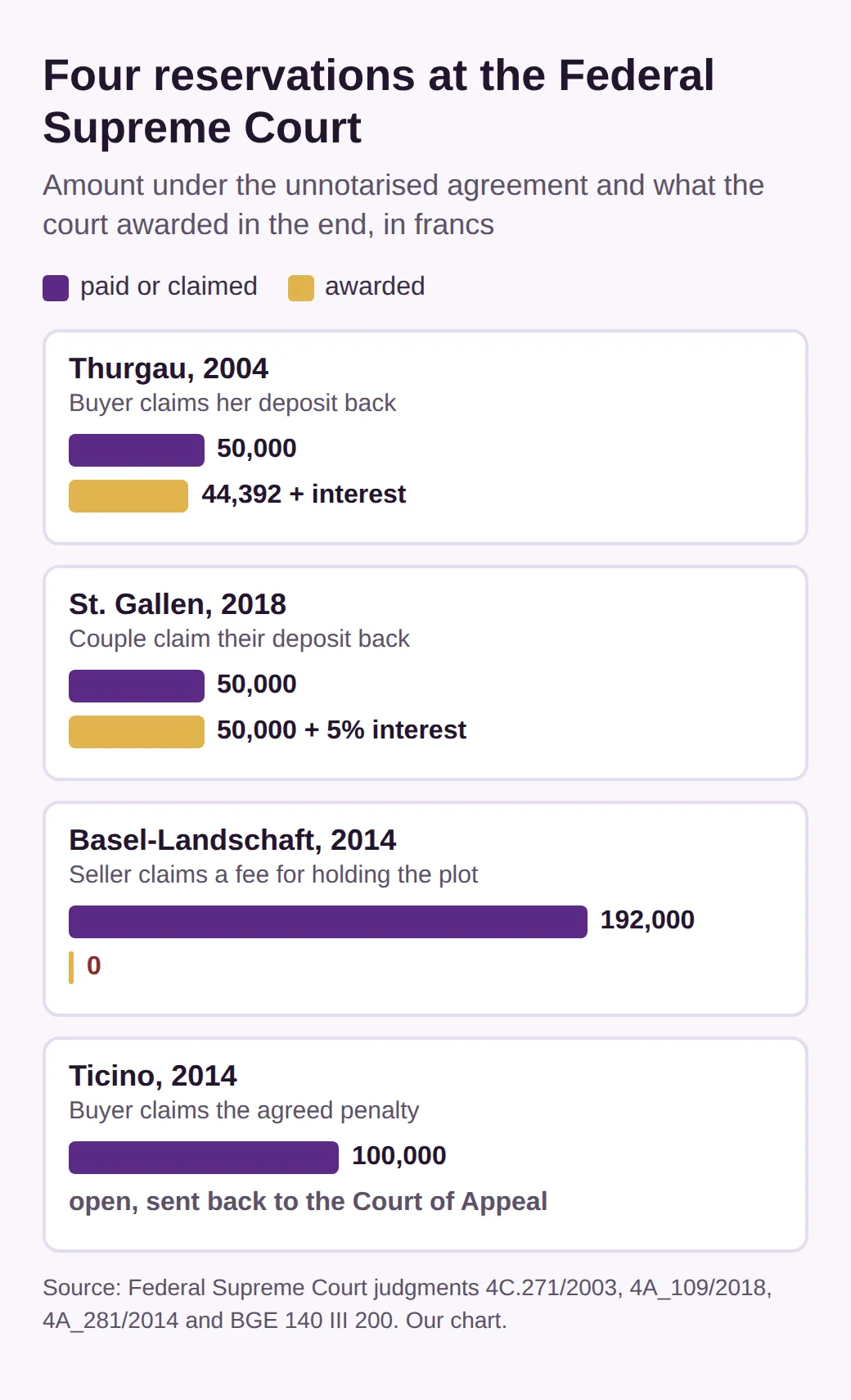
In March 2000, a buyer reserved building land and farmland for a total of CHF 363,000 and paid a deposit of CHF 50,000. Under the agreement, the deposit was to be forfeited as compensation for costs and trouble if she failed to buy for a reason she was responsible for. The appointment with the notary was planned for 1 April 2000 at the latest, but it never took place. In July, the buyer asked for her money back, saying she had not been told that a pig-fattening farm lay close by.
The Münchwilen District Court awarded her CHF 44,392.40 plus interest, and the Thurgau High Court upheld the award. The Federal Supreme Court declined to hear the seller's appeal (judgment 4C.271/2003). It let the lower court's reasoning stand: the reservation agreement was a preliminary contract lacking the required form, the forfeiture clause was subject to the same formal requirement, and the buyer was not abusing her rights by relying on that. Why she did not get the full CHF 50,000 back is not stated in the federal judgment.
St. Gallen 2018: the loft house
In May 2013, a married couple signed a reservation for a loft house still to be built, with estimated total costs of CHF 1.54 million. They paid a deposit of CHF 50,000, to be credited against the price of the land and two garage spaces. In September 2014, the couple dropped the project and asked for the deposit back by 25 September. The seller did not pay and relied on two clauses under which he was to keep the money as compensation for his work.
All three courts ruled for the couple, the last being the Federal Supreme Court in judgment 4A_109/2018: CHF 50,000 plus 5 percent interest from 26 September 2014. What decided it was that, under the agreement, the deposit was to be forfeited even if the couple withdrew through no fault of their own, for instance because the seller fell behind schedule. A clause like that is meant to tie the buyer to the preliminary contract, and that takes a notary. The court also rejected the argument that the couple were abusing their rights: a preliminary contract is only fulfilled once the purchase contract has been signed, and a deposit is merely part performance.
Basel-Landschaft 2014: CHF 192,000 for holding a plot
Here it was the seller who wanted money. A company planned to build a branch on a plot with a factory building and, in December 2010, signed a preliminary contract with the owner for CHF 2,016,000, without a notary. If the purchase did not go ahead, it was to pay CHF 8,000 for each month of reservation, and in certain cases twice that. At the end of 2011 the buyer pulled out, and the seller demanded CHF 192,000. The Federal Supreme Court dismissed his claim (judgment 4A_281/2014): the payment was owed only if the purchase fell through, so it was meant to push the buyer into buying, and without a public deed it was invalid.
When the seller may keep something after all
A seller does not always walk away empty-handed. Compensation is valid even without a notary if it only covers the costs someone incurred relying on the purchase, for planning, say. The court calls this the negative interest, also known as the reliance interest. It set out the principle in 2014 in a case from Ticino (BGE 140 III 200). There, the parties had agreed in a lettera d’intenti on condominium units in a hall for CHF 500,000. They knew about the formal requirement and still agreed a penalty of CHF 100,000 for whichever side backed out. The seller then sold the land to third parties.
The Federal Supreme Court held that the seller was entitled to rely on the missing form. But it sent the case back to the Ticino Court of Appeal to establish whether the penalty was only meant to make good the buyer's reliance loss. In that case it would be valid, and the court would have to reduce an excessive penalty under Art. 163 para. 3 CO. On top of that comes fault in contract negotiations: anyone who agrees to a contract in principle and then refuses at the last moment to have it notarised acts contrary to good faith and may have to compensate the other side's loss.
For you, that means two things. If a seller holds back part of the deposit, ask for an itemised statement with receipts. The Zurich notaries' offices write that, in principle, the seller may only keep the costs of actual expenses incurred in good faith, and in St. Gallen the seller failed precisely because he did not prove his loss in detail. The rule also works against you: if you string a seller along until the end, you may owe them their costs. All of this only helps you, though, if the money is still there.
The real risk: money that is already gone
A right to repayment is worth nothing if the recipient cannot pay. The Zurich notaries' offices warn that the money is usually lost if the seller becomes insolvent before ownership passes. Two criminal judgments show what that looks like.
In the canton of Lucerne, a buyer paid a deposit of CHF 70,000 on an apartment under a reservation agreement. If the purchase fell through, she was to get the money back minus CHF 7,000 for the seller's trouble. The recipient spent it bit by bit. The Lucerne Cantonal Court convicted him of criminal misappropriation, and the Federal Supreme Court upheld that in November 2023 (judgment 6B_902/2023). The criminal court had not ruled on the buyer's civil claim, so the criminal case did not decide what happened to her money.
In Basel-Stadt, the courts convicted a property agent of fraud for commercial gain, and the Federal Supreme Court upheld the conviction in October 2025 (judgment 6B_360/2025). One client had transferred a reservation payment of CHF 100,000 for a project the agent had made up. The contract expressly promised that it could be cancelled at any time, with the full fee then returned. Another client paid CHF 35,000 for a detached house into the agent's private account. In a further case his account stood at CHF 1.20 before the transfer, and in several cases the owners of the properties never heard about the prospective buyers.
The lesson is simple. Check who owns the house before you transfer a single franc. Anyone can get the owner's name from the land registry without having to show an interest (Art. 970 para. 2 CC). Never pay in cash and never directly to someone who is not the owner, not even to an estate agent. And a repayment clause is only worth as much as the person who signed it.
How to pay a deposit safely
The safest option is no deposit before the deed is signed. If the seller insists, the money should sit with a party that may neither spend it nor mix it with its own funds. The official Swiss portal ch.ch notes that you can ask the seller to have the money paid into a special blocked account.
The second option is a notary's client account, in cantons where notaries work in private practice. The Notaries Ordinance of the canton of Bern (in German) shows how strictly such money is protected. Under Art. 28, the notary must keep money entrusted to them separate from their own and may not use it for themselves, not even temporarily. If they hold more than CHF 20,000 for one client, they must deposit it within 40 days with a Swiss bank in the client's name or in a trust account naming the person entitled to it. Under Art. 30 they must be able to pay out everything at any time, and under Art. 11 they need professional liability insurance of at least CHF 2 million a year. Other cantons have their own rules; ask your notary how they would hold a deposit.
Whether you use a blocked account or a notary, set out in the reservation, and in your instructions to whoever holds the money, when the money goes where. A short clause is enough:
The reservation payment of CHF [amount] will be paid into [blocked account / client account of notary name]. It will be credited against the purchase price when the deed is signed. If the purchase contract is not notarised by [date], it will be returned to the buyer in full within 10 days. Deductions are allowed only for costs the seller proves item by item.
If you really want to commit
If you want a binding hold on a property, have the reservation notarised. This can be a notarised preliminary contract or a right of purchase. A right of purchase may be agreed for at most ten years and recorded in the land register by priority notice (Art. 216a CO). The priority notice can be invoked against any right acquired later (Art. 959 CC). That is exactly what the buyer lacked in the Ticino case, where the seller simply sold the land to third parties.
A public deed costs money. In the canton of Zurich, the notarial fees ordinance (in German) sets the same rate for a preliminary contract and for granting a right of purchase as for the purchase contract, at least CHF 100, and recording the notice in the land register carries a fee of its own. What the notary and land registry charge in your canton is covered in our post on purchase costs by canton. If the purchase contract will be ready in a few weeks anyway, it is often simpler to notarise that straight away. The next section shows the steps that get you there.
From reservation to land register
Between the reservation and ownership lie five more steps, and the house is only yours at the very end. The law sets no deadlines for them; how fast it goes depends on your bank, the notary's office and the land registry.
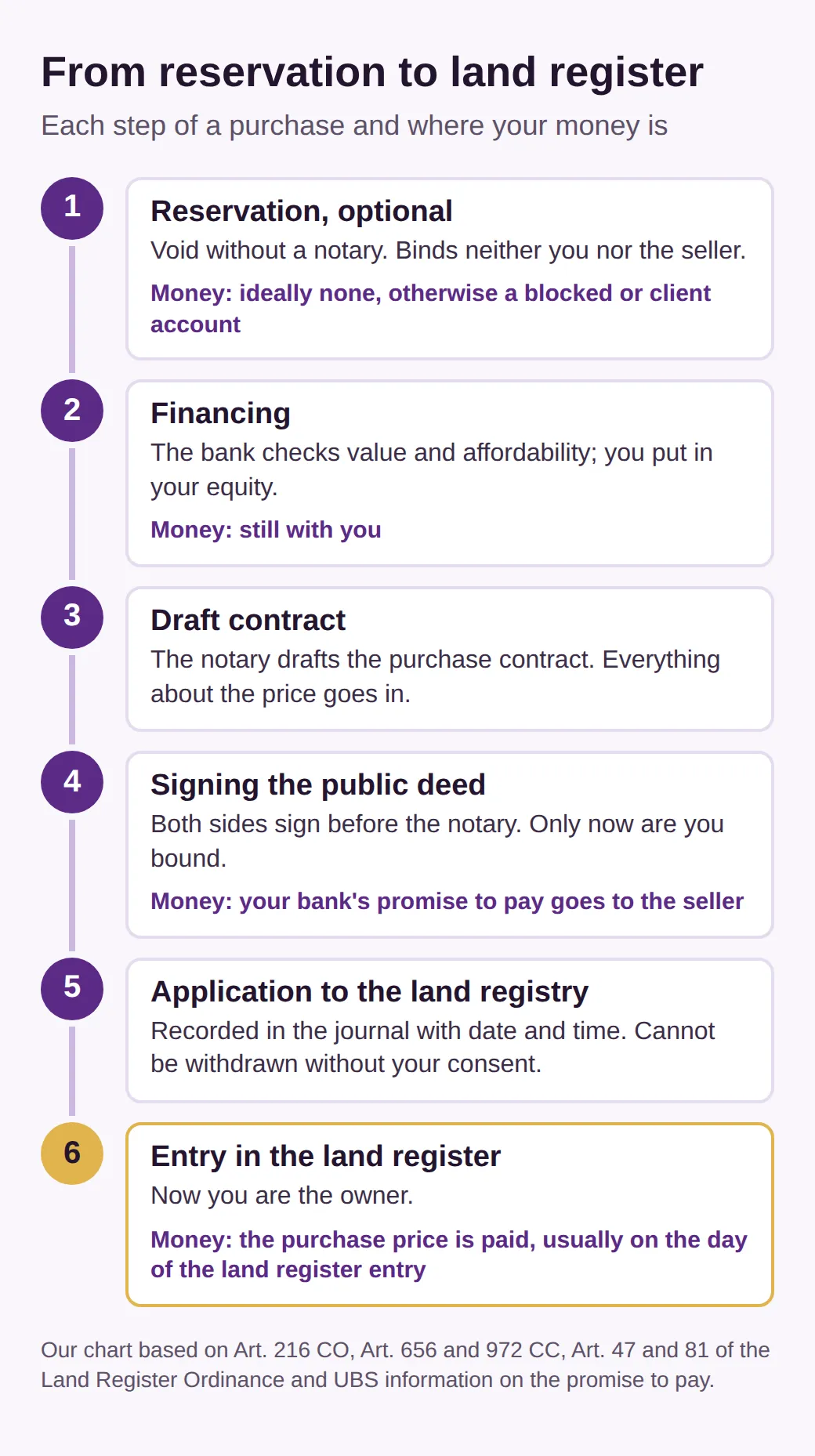
After the reservation, you sort out the financing. The bank checks the value of the property and whether you can carry the mortgage; how it calculates this is covered in our posts on affordability and on equity. Meanwhile, the notary prepares the contract. In Zurich, the same office handles both the public deed and the application to the land registry. You give it the details of the transaction, it goes through the contract with you and, once the draft is final, sets the date, as the notaries' offices describe (in German).
At the notary appointment, both sides sign the deed, and only now are you bound. The bank guarantees the purchase price to the seller with an irrevocable promise to pay, at the latest at signing, as UBS explains. According to UBS, the purchase price itself is normally transferred on the date of the land register entry.
The notary then files the purchase with the land registry. The application is unconditional and cannot be withdrawn without the consent of the beneficiaries (Art. 47 Land Register Ordinance, in German). The registry records it in the journal straight away, with the date and exact time (Art. 81). It then checks the form, the right to dispose and any permits needed, for example under the Lex Koller, which can apply to buyers from abroad (who it affects). Once you are entered in the main register, you become the owner (Art. 656 CC), with effect back to the moment of recording in the journal (Art. 972 CC). If the purchase collapses before that, a different sequence begins.
If the purchase falls through: how to get your money back
Ask for the deposit back in writing and set a deadline. The St. Gallen couple did exactly that, with a letter of 7 September and a deadline of 25 September 2014. Once the deadline has passed, the recipient is in default (Art. 102 CO) and owes default interest of 5 percent a year (Art. 104 CO). A short letter, sent by registered post, is enough:
On [date] I transferred CHF [amount] to you for the property at [address] under the reservation agreement of [date]. The agreement is void because it was not made as a public deed (Art. 216 para. 2 CO). Please repay the amount to account [IBAN] by [date]. If you claim any costs, please set them out with receipts.
If the recipient does not pay, the next steps are debt collection proceedings and, if they lodge an objection, conciliation proceedings and a lawsuit. The couple in St. Gallen took this route all the way to the Federal Supreme Court. Your claim becomes time-barred three years after you learn of it, and at the latest ten years after it arose (Art. 67 CO). Whether going to court pays off depends on the amount and on whether the recipient still has anything to recover; a legal advice service or your legal expenses insurance can assess that beforehand.
Better still, never let it get that far. When you view the property, ask which notary's office is to notarise the purchase contract and whether the reservation payment can be lodged there. Someone who dodges that question tells you more than any clause. You'll find houses and apartments across Switzerland on our home page.
Common questions
Can the seller sell to someone else even though I reserved the property?
Yes, if the reservation was not notarised, because then it does not bind the seller. They must pay back your deposit. If they kept you believing until the last moment that the sale would go ahead, they may also have to cover the costs you incurred in reliance on it, under the rules on fault in contract negotiations.
Do I have to pay the reservation fee if I have already signed?
No. The Zurich notaries' offices state that you can refuse to pay despite your signature, as long as you have not paid yet. Tell the seller early and clearly that you will not pay, though, so they do not run up further costs counting on your purchase.
How long do I have to claim a property deposit back?
A claim for unjust enrichment becomes time-barred three years after you learn of it, and at the latest ten years after it arose. This is set out in Art. 67 CO. Even so, do not wait: the longer the money sits with the recipient, the greater the risk that it is gone.
Does this also apply to an off-plan apartment bought from a general contractor?
For the part that concerns the land or the condominium unit, yes. In the St. Gallen loft house case the deposit was credited against the price of the land, so the formal requirement for buying land applied. A pure construction contract for the building work, on the other hand, can in principle be valid without a notary.
Is interest due on a deposit the seller does not repay?
From the day the recipient is in default on repayment, they owe default interest of 5 percent a year. They are in default once you send a reminder or once a deadline you set has passed. In the St. Gallen case, interest ran from the day after the deadline the buyers had set.
More from the blog
All posts
Property transfer tax in Switzerland by canton: 2026 costs
Property transfer tax, notary and land registry fees in Zurich, Bern, Vaud and Aargau: the legal rates, who pays and what a CHF 1m apartment costs.

Buying a house in Switzerland as a foreigner: 2026 rules
Who can buy property without authorisation: EU/EFTA, B, C, L and G permits, non-EU buyers, holiday homes, land, moving away and the planned Lex Koller reform.

Condominium renovation fund in Switzerland: how much to pay?
Renovation fund in a Swiss condominium: recommended contributions, a worked example in francs, the rules, the owners' meeting and the 2029 tax change.