House viewing checklist: what to check in Switzerland
The essentials first
At a house viewing, check five things above all: damp in the basement and in the corners, the roof from the attic, the age and condition of the heating, the windows and, in houses built before 1990, possible asbestos. Ask for the land register extract, the plans and the receipts beforehand, and bring an expert to the second viewing.
The reason for being this thorough is in the purchase contract. When you buy a house that has been lived in, Swiss contracts usually exclude the seller's liability for defects. Whatever you miss at the viewing, you pay for yourself afterwards. Many checklists online come from Germany and quote rules that do not apply here. This one follows Swiss law and the information published by the federal government and the cantons, and it shows which maps, certificates and experts exist only here.
Why the viewing is your most important protection
Anything you could have seen at the viewing is your problem once you have bought. The Code of Obligations puts it like this: for defects that "any normally attentive buyer should have discovered", the seller is liable only if they expressly assured you that the defects do not exist (Art. 200 CO, in German).
Then there is common practice at the notary's. In a fact sheet on warranty law (in German) from 2015, the land registry office of the canton of Schaffhausen says that for existing buildings it is customary to exclude the warranty as far as the law allows. The seller is then liable only for defects they concealed intentionally or fraudulently, because an exclusion never covers those (Art. 199 CO). The office draws the conclusion itself: it is in the buyer's interest to inspect the house carefully before signing the contract, with an expert if possible.
Revised rules on construction defects have applied since 1 January 2026. For purchase contracts from that date, you have 60 days to report a defect, and for a hidden defect the 60 days run from the moment you discover it. Your claims become time-barred five years after ownership passes to you. The contract can no longer shorten either period to your disadvantage (Art. 219a CO). If you buy a house that is still being built or is less than two years old, you can also demand that defects be repaired free of charge, and according to the Federal Council (in German) a contract can no longer exclude this right. For an older house, this changes little, because the exclusion is still allowed. So your inspection starts at your desk, days before the viewing.
Before the viewing: which documents to ask for
Ask the seller or the estate agent for the key documents before the first viewing. What they cannot provide tells you something too. A short message is enough:
Hello. We are interested in the house at [address] and would like to prepare well for the viewing. Could you send us the land register extract, the plans, a list of the renovations since the house was built with the year and the invoice, the service records for the heating, the latest electrical safety certificate and, if there is one, the GEAK energy certificate? Are you aware of any water damage or damp problems? Many thanks and kind regards
The land register extract shows ownership, mortgage liens and easements, such as a neighbour's right of way across your forecourt or a pipe running through the garden. Read it carefully, because ignorance is no defence here: "An objection based on ignorance of a land register entry is inadmissible" (Art. 970 Civil Code).
Restrictions the state places on the property are not in the land register but in the cadastre of public-law restrictions on landownership (PLR cadastre, ÖREB-Kataster). There you will find building zones, building lines, water protection, the minimum distance from woodland, noise protection and heritage protection. The extract is free and available online straight away, as the canton of Solothurn (in German) notes; Zurich offers it through its geoportal (in German). Only the underlying decisions are legally binding, though; the extract is for information only. If you want to build an extension or convert the attic, it is still the first document to read.
The GEAK, the cantons' energy certificate for buildings, rates the house in seven classes from A to G. The extended version, GEAK Plus, sets out up to five ways of modernising the house's energy performance, according to geak.ch (in German). If there is one, you already hold an expert opinion on the insulation, windows and heating. Two more sources cost nothing and are just a click away.
Two maps you can check from your sofa
On map.geo.admin.ch, the federal government shows for every address whether water flows across the land in heavy rain and how likely high radon levels are. You will see neither at a viewing.
The surface runoff hazard map of the Federal Office for the Environment (FOEN) shows where rainwater flows over fields and roads during a rare heavy rainfall. This means events that happen, on average, less often than once in a hundred years. If the house lies in a purple area or at the end of a channel, take a particularly close look at the light wells, basement stairs and garage driveways at the viewing.
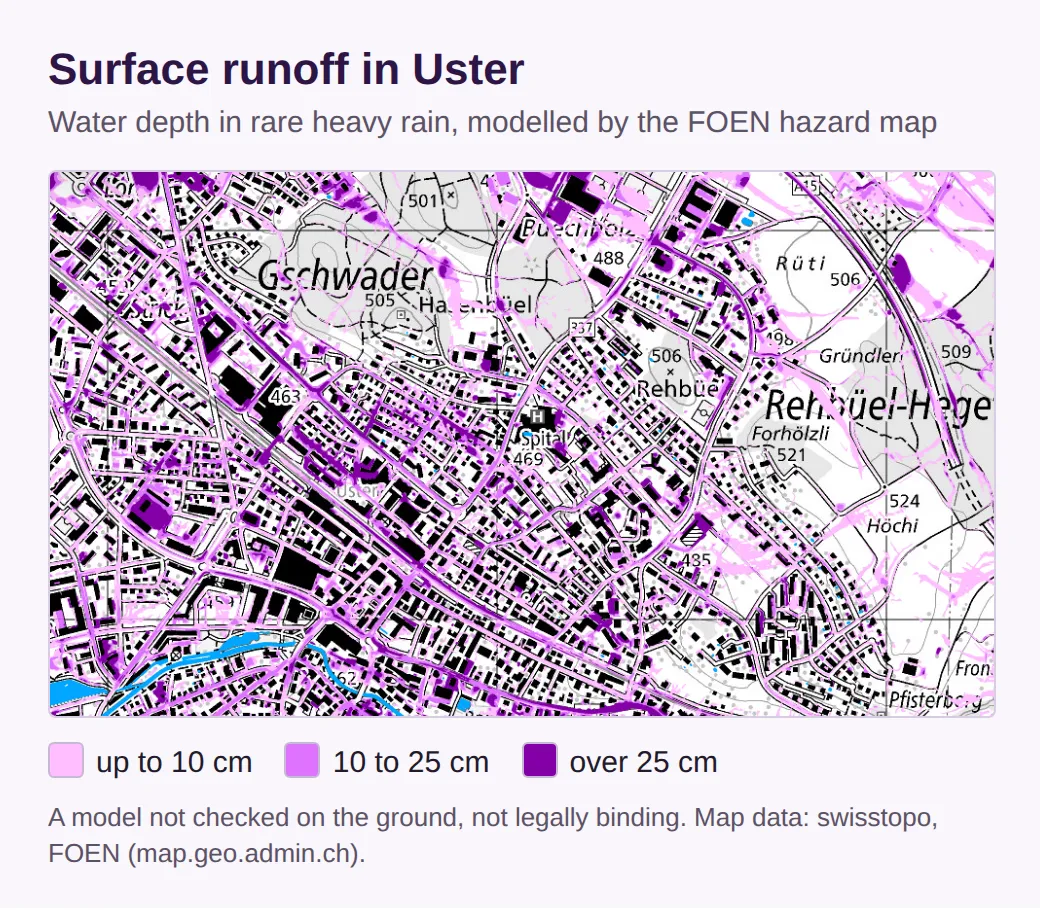
The map is based on a model and has not been checked on the ground. The FOEN states that it has no legal force and must not be read in more detail than at a scale of 1:12,500. So it does not tell you whether your basement will get wet, but where you should ask. It does not show flooding from streams and rivers; for that, the cantons publish their own hazard maps.
The second layer is the FOPH radon map. For each square kilometre, it shows how likely a building is to exceed the reference level of 300 becquerels per cubic metre. Radon is a gas that, according to the Federal Office of Public Health (FOPH), seeps into houses from the ground. What the map means for your decision to buy comes further down, after the walk through the house.
The walk through the house
Go through the house systematically, not in the order the estate agent suggests. If you start in the nicest room, you look less closely in the basement.
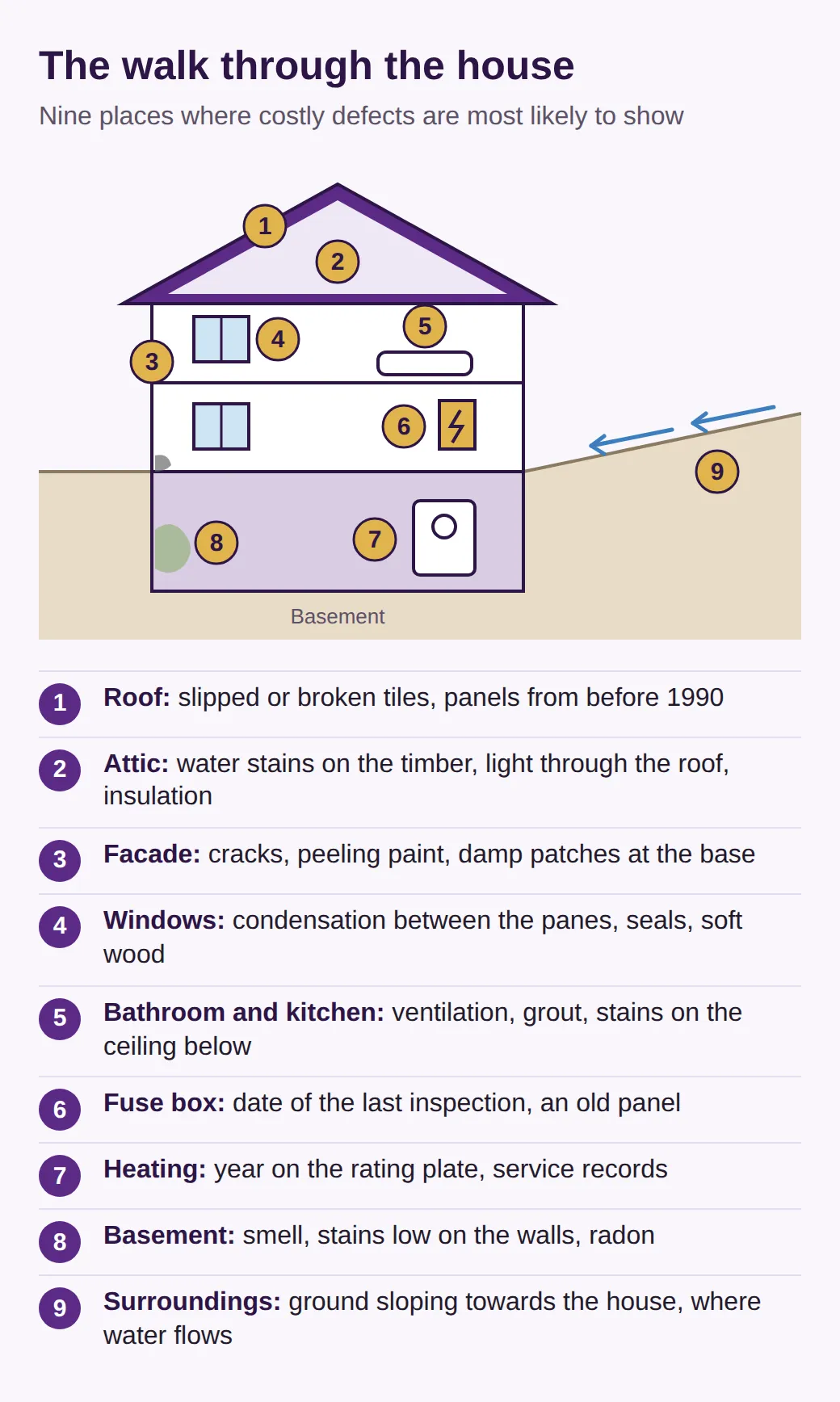
Bring a torch, your phone for photos and the plans. Photograph rating plates, cracks and stains so that you and your expert can compare later. And remember that fresh paint is not always just cosmetic: a single freshly painted patch of wall in a corner is worth a question.
Damp: your nose, the corners, the basement
Damp is what most easily stays hidden during a short viewing, and your nose often finds it first. The City of Bern's fact sheet on mould (PDF in German) names a musty smell as a frequent sign of mould. Mould grows where the relative humidity at the surface of a material stays at 70 to 80 percent for a long time.
The city lists these structural causes: poor insulation and thermal bridges, water getting in through a flat roof or terrace, rising damp from inadequate waterproofing and a lack of ventilation in the kitchen and bathroom. That tells you where to look: into the corners of the outside walls, behind cupboards on outside walls, at the ceiling below the bathroom and terrace, and low down on the basement walls. Stains, peeling paint and white crusts at the bottom of a wall are warning signs.
A small spot in a joint does not mean structural damage; for surface mould up to 10 by 10 centimetres, the Bern fact sheet does not consider action essential. Larger areas, mould in several places or a clear smell with no visible mould are a different matter. Then what counts is the cause, and an expert is more likely to find it than you are. Often it lies further up.
Roof and attic
You see a roof best from the inside. Climb into the attic, switch off the light and check whether daylight shows through the tiles. Dark edges on the timber or the insulation show where water once stood. From outside, the zoom on your phone shows slipped or broken tiles and the state of the metal flashing around the chimney and along the edge of the roof.
With a flat roof, ask in which year it was last waterproofed. And with a house built before 1990, take a look at any fibre cement roof and facade panels, because they may contain asbestos. More on that below. From the top, you move on to the windows.
Windows and facade
Windows give away the age of a house faster than any list. Condensation or streaks between the panes mean the insulating glass is no longer sealed. Check the rubber seals, open and close every window, and on wooden frames press into the bottom corner: if the wood gives, it is rotten.
On the facade, look for cracks, peeling paint and dark patches at the base, where rain splashes up and moisture rises from the ground. Fine hairline cracks in the render are common; wide cracks running diagonally from the corners of windows should be shown to an expert. How urgent all this is depends mainly on how old the parts are.
How old is what? The service life of building parts
A house ages one part at a time. The heating wears out far sooner than the windows, and the roof structure outlives both. If you know which part was fitted in which year, you can roughly plan the next expenses.
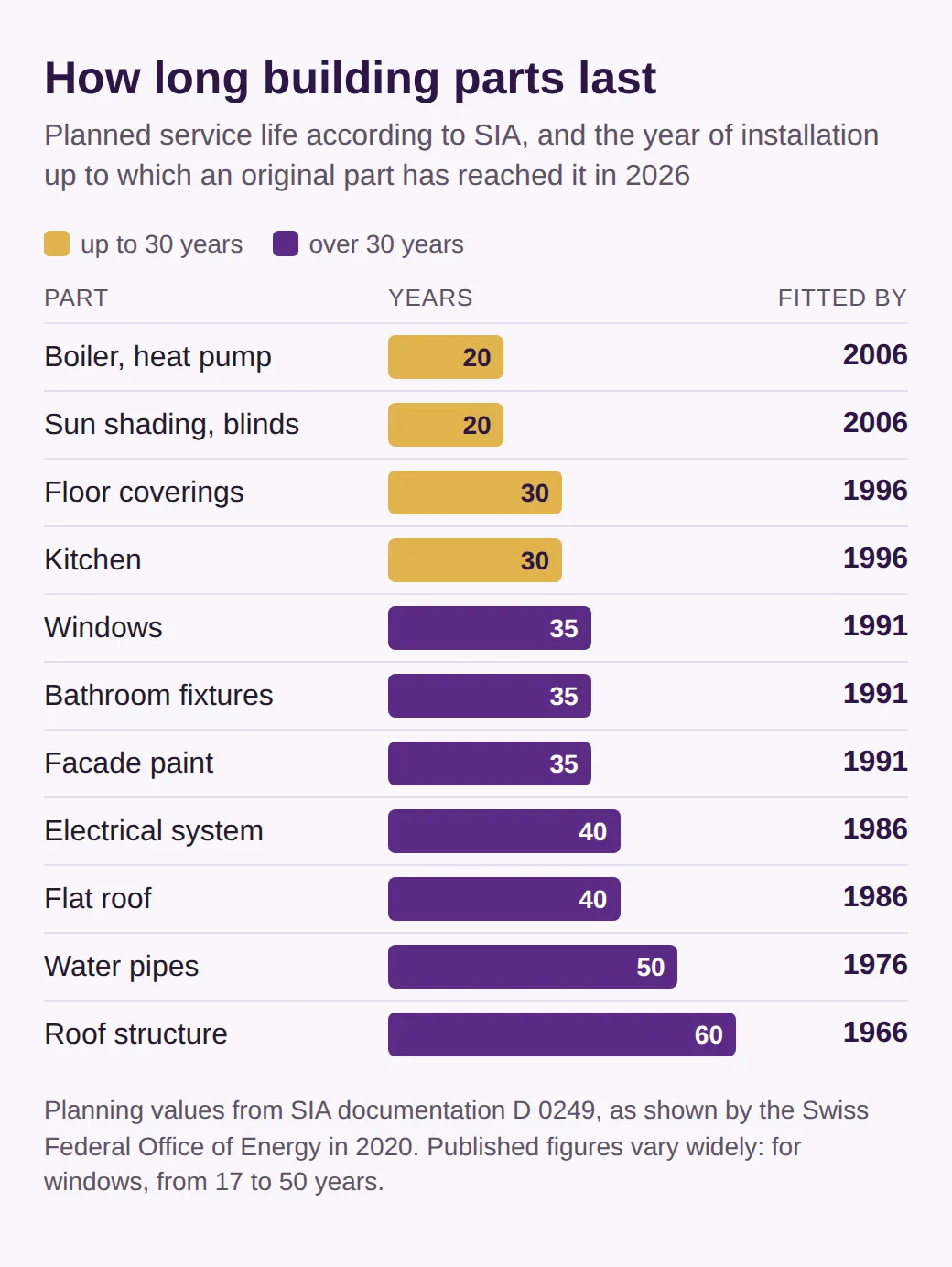
The figures are planning values from the Swiss Society of Engineers and Architects (SIA), as shown in a paper by the Swiss Federal Office of Energy (PDF in German) on the DUREE research project. The same project shows how imprecise such values are: the specialist literature gives 11 to 22 years for heat pumps and 17 to 50 for windows. So a well-maintained window from 1985 may still work, while a poorly maintained one from 2000 may already be at the end of its life.
The researchers also found that owners in Switzerland usually renovate only well after the service life has run out, and that around 20 percent of hundred-year-old houses still have their original roof and facade. For you, this means that in a house from 1995 where nothing has ever been replaced, the heating, blinds, floors and kitchen have already passed their planning values, and the windows will follow around 2030. So ask for proof of every renovation, with the year and the invoice. The most money, and the most rules, are in the heating.
The heating and your canton's rules
With the heating, what matters is not only its age but also what you are allowed to install when you replace it. The year of manufacture is on the rating plate on the unit; take a photo of it. Ask for the service reports from recent years and, for an oil or gas boiler, the reports from the emissions checks.
In the canton of Zurich, replacing a heating system (in German) means installing renewable energy if this is technically possible and costs no more than five percent more over its whole service life than a new oil or gas boiler. Every heating replacement needs a permit. Fixed electric heaters must be replaced by 2030. In practice, hardly any fossil heating is approved any more: in ten municipalities, from September 2022 to August 2023, the first year after the law came into force, fossil systems made up 1.3 percent of 379 applications, as the canton reports in an evaluation (in German).
So if you buy a house in the canton of Zurich with a 20-year-old oil boiler, budget for the price of a heat pump, a wood-fired system or a district heating connection. A new oil boiler is hardly an option. The rules differ from canton to canton; your canton's energy office can tell you more and knows about the subsidies. It is best to get a quote for the replacement before you sign, so that you can negotiate the price. Two risks that even an expert cannot see with the naked eye are asbestos and radon.
Asbestos and radon: what the year of construction and the location tell you
Whether a house may contain asbestos depends on when it was built; whether radon is an issue depends on where it stands. Only samples or measurements can settle either question for certain.
According to the Federal Office of Public Health (in German), asbestos is found in building products from roughly 1904 to 1990, above all in houses from the 1950s to the 1970s. Suva (in German), the Swiss accident insurer, dates the ban to 1990 and names tile adhesive, plaster, window putty, roof and facade panels, floor coverings, insulation, corrugated sheets and old fuse boxes as typical places. You cannot recognise it with the naked eye, only with a laboratory analysis.
With normal use, the FOPH says the risk from most building products is low; it becomes dangerous as soon as someone drills, sands or saws. Some materials are risky even when only lightly disturbed, though, such as sprayed asbestos or insulation made of asbestos board behind radiators and under windowsills. For a purchase, what counts above all is money: if you plan a new kitchen, a new bathroom or new windows, you must first find out whether asbestos is involved, and removal by specialist firms costs money. With a house built before 1990, the question belongs in every conversation.
For radon, a reference level of 300 becquerels per cubic metre as an annual average has applied since 2018 to rooms where people regularly spend several hours a day. According to the FOPH (in German; the English page is shorter), a recognised measurement takes a year, or at least 90 days in the heating season from October to March. That rarely fits into a purchase. A short-term measurement is not a recognised measurement, but the FOPH says it is suitable for a quick assessment, for example when buying a house. Some cantons offer free measurements; Basel-Stadt, Bern, Solothurn, Vaud and Zurich do not. If the radon map shows a high probability for your location, the issue belongs in the negotiations, just like the next point.
The electrical safety certificate
When a house is sold, the electrical installation must be inspected if the last inspection was more than five years ago. The Low-Voltage Installation Ordinance (NIV, in German) requires this in its annex for all installations with a ten- or twenty-year inspection period. An ordinary house is usually inspected every 20 years anyway.
The inspection ends with a safety certificate (Sicherheitsnachweis, or SiNa for short). Ask for the latest one. Under the ordinance, the owner is responsible for a safe installation and must have defects repaired without delay. Once you have bought, that is you. Agree in the contract who orders the inspection for the sale and who pays for the defects it finds. You can spot an old fuse box with screw-in fuses at the viewing; what lies behind it, an expert will see.
When to bring in experts
By the second viewing at the latest, and in any case before you sign, an independent expert should see the house. What matters is that they work for you and not for the seller or the estate agent.
Which expert depends on what you have seen. For the overall condition, an architect or a building consultant with experience in older buildings is a good choice; they can also estimate what the next ten years will cost. For asbestos, Suva recommends a specialist who sends material samples to a laboratory, and for radon the FOPH keeps a list of approved measurement services. The electrical inspection is done by an independent inspection body licensed by the Federal Inspectorate for Heavy Current Installations (ESTI), and the GEAK by a certified GEAK expert.
We found no reliable guide price for such an inspection in any official source. So ask in advance for a written quote that sets out the scope: site visit, short report, cost estimate. Compared with the purchase price, it is a small item, and the report can change a lot once it comes to the contract.
What goes into the contract after the viewing
Everything the seller assures you of at the viewing belongs in the purchase contract in writing. Only then are they liable for it, even if the contract otherwise excludes the warranty. The Code of Obligations treats such assurances as a warranty of quality (Art. 197 CO, in German), and under Art. 200 they apply even where you could have seen a defect yourself.
After each viewing, write a short record: what you saw and what the seller said, with photos and the date. That gives you the questions for the notary and the wording for the contract, such as that no water damage is known, that the flat roof was waterproofed in a given year or that the seller pays for the electrical inspection. With your expert's cost estimate, you negotiate the price instead of bearing a defect alone after the purchase.
Build the upcoming renovations into your budget before you commit. They change how large a mortgage you can afford (how banks calculate affordability), and they come on top of the buying costs in your canton. Major work also comes with a tax deadline: maintenance costs for an owner-occupied house can only be deducted until the end of 2028. According to the Federal Council (in German), the deduction ends on 1 January 2029, together with the imputed rental value. And if a house fails the viewing, the effort was not wasted: you have saved yourself a costly mistake.
Common questions
How many times should you view a house before buying it?
At least twice. The first visit tells you whether the house and the location suit you at all. For the second, bring the documents, your questions and an expert, ideally at a different time of day and after rain, so you see the light, the noise and any damp under different conditions.
Can I take photos and measurements during a house viewing?
Ask first, and it is usually no problem. Photos of rating plates, cracks, stains and the fuse box will help you and your expert later more than any note. Taking material samples, for asbestos for example, needs the seller's express consent, because something gets removed.
What else should I check when buying a condominium apartment?
Besides the apartment itself, the shared parts count, such as the roof, facade, heating and underground car park, because you help pay for them. Ask for the owners' association rules, the minutes of the last few meetings and the balance of the renovation fund. They show which renovations are planned or disputed.
Can a seller in Switzerland hide a defect they know about?
No. If the seller fraudulently concealed a defect, a clause in the contract excluding the warranty does not cover it. But you have to prove that they knew. So ask in writing about any known damage and have the answers included in the contract.
Do I need a radon test before buying a house in Switzerland?
Buyers have no legal duty to measure. A recognised measurement takes a year, or at least 90 days in the heating season, so it rarely fits into a purchase. A short-term measurement gives a first indication, but according to the FOPH it is not a recognised measurement. If the radon map shows the house in an affected area, raise the issue in the contract.
More from the blog
All posts
Imputed rental value abolished in 2029: who wins, who pays
Imputed rental value ends on 1 January 2029: what applies until 2028, what goes, how the first-time buyer deduction works and at what rate you lose out.
Reservation agreement in Switzerland: is your deposit lost?
Without a notary, a Swiss property reservation agreement is void. What the top court ruled on deposits, how to pay safely and the steps to the land register.

Buying a house in Switzerland as a foreigner: 2026 rules
Who can buy property without authorisation: EU/EFTA, B, C, L and G permits, non-EU buyers, holiday homes, land, moving away and the planned Lex Koller reform.