Imputed rental value abolished in 2029: who wins, who pays

The short answer
The imputed rental value will be abolished on 1 January 2029. The Federal Council decided this on 1 April 2026. Up to and including tax year 2028 you keep paying tax on it and deduct mortgage interest and maintenance as before. From 2029 the imputed rental value and those deductions disappear. There are exceptions for first-time buyers, for landlords and for listed buildings.
Many websites still say 2028 or talk about "at the earliest". That is out of date. We show exactly what was approved on 28 September 2025, what is in the law and what is not, and work out for three households whether they will pay more or less tax from 2029. Our sources are the federal act itself and the documents of the Federal Department of Finance (FDF) and the Federal Tax Administration (FTA).
Why 2029 and not 2028?
The Federal Council chose the date because the cantons need time to change their own laws. In its press release of 1 April 2026 (not published in English), it points to the Tax Harmonisation Act, which as a rule gives the cantons at least two years to adapt. In the consultation, most members of the Conference of Cantonal Finance Directors had called for a start no earlier than 2029. Then there is the new tax on second homes: cantons that want one should be able to bring it in at the same time as the imputed rental value ends.
Strictly speaking, the vote on 28 September 2025 was not about the imputed rental value at all. On the ballot was the Federal Decree on Cantonal Property Taxes on Second Homes, an amendment to the Constitution. The people and the cantons accepted it with 57.7 percent of the vote, as the FDF records. No one had launched a referendum against the actual federal act on the change of system for taxing home ownership of 20 December 2024. But the act can only come into force together with the decree, so the yes vote also settled the fate of the imputed rental value.
For your tax return this means: the return for 2028 is the last one with an imputed rental value, a maintenance deduction and the full interest deduction. Tax year 2029, which you file in 2030, is the first under the new system. What you should still do before then depends on exactly what goes.
What goes and what stays
The imputed rental value goes, and so do almost all the deductions tied to it. That applies to federal, cantonal and communal tax, and to main homes as well as second homes.
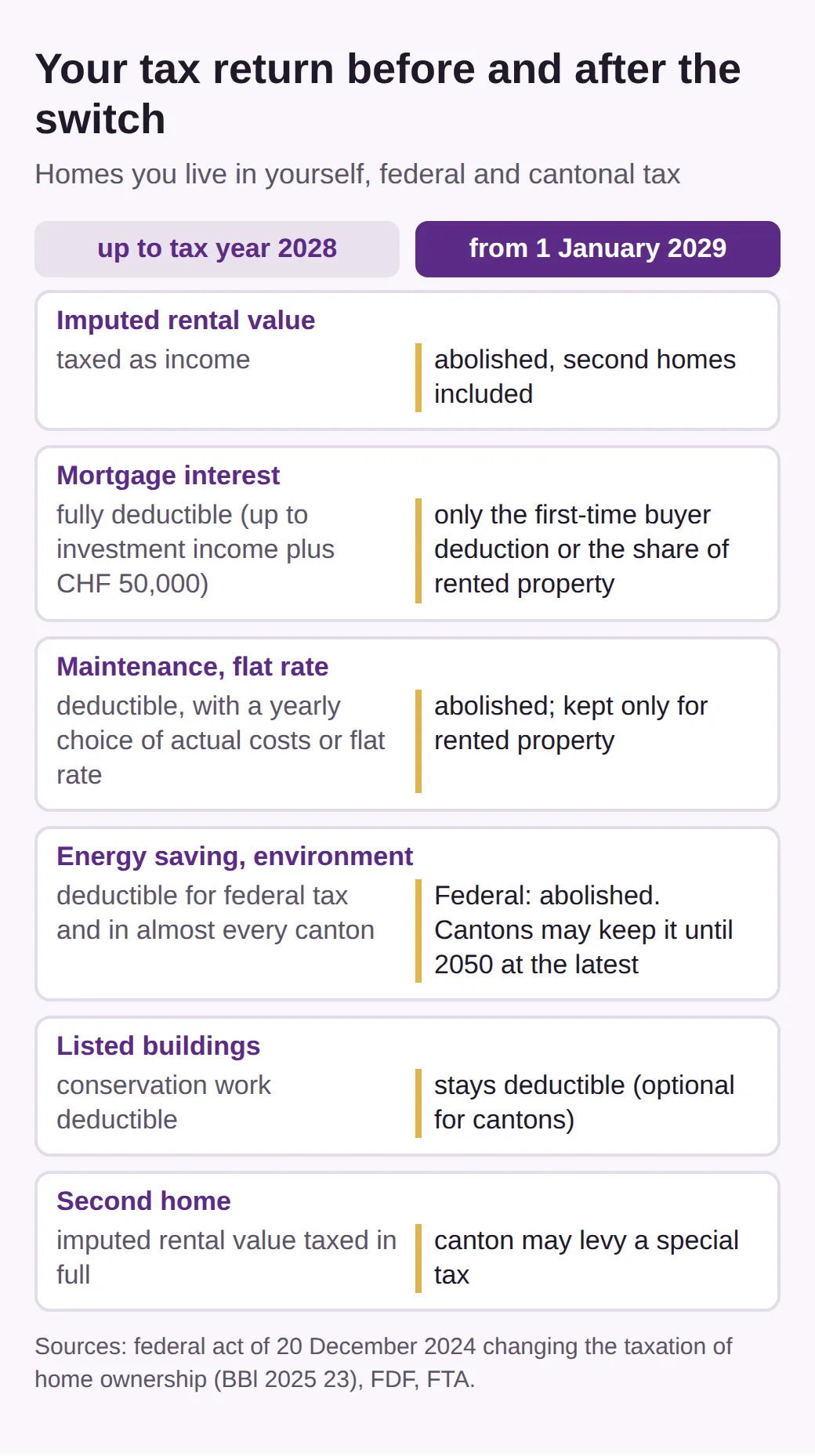
Today the imputed rental value is the amount you pay income tax on because you pay no rent in your own home. According to the FTA's tax dossier, for direct federal tax it may not be set below 70 percent of the market rent, on average across a canton. From 2029 you no longer pay tax on it.
In return, the deduction for maintenance costs goes. Today you can choose every year whether to deduct your actual costs or a flat rate: for federal tax, 10 percent of the imputed rental value for buildings up to ten years old and 20 percent for older ones. From 2029 both options exist only for rented property.
The biggest cut is to the deduction for interest on debt. Today you can deduct private interest up to the amount of your investment income plus CHF 50,000. From 2029 you can only deduct it in proportion to how much of your total assets your rented property makes up. That covers every kind of debt, including a consumer loan or a Lombard loan against securities. If all you have is a home you live in and a bank account, you cannot deduct any interest at all, unless you are a first-time buyer.
For investments in energy saving and environmental protection, the deduction disappears entirely for direct federal tax. Under the new law the cantons may keep it until the target of net zero greenhouse gas emissions is reached, and until 2050 at the latest. Whether your canton will do that is open. Graubünden, for example, plans to drop it. The only thing that stays deductible is the cost of conservation work on listed buildings: for federal tax as a fixed rule, for cantonal tax at each canton's choice.
Whether all this works out in your favour depends almost entirely on one figure: your mortgage interest compared with your imputed rental value.
Who wins, who loses? Three examples
You come out ahead as long as your imputed rental value is higher than your interest plus your maintenance deduction. Once the interest climbs above that, you pay more. To make this concrete, we take an example house with an imputed rental value of CHF 25,000 a year. It is more than ten years old, so the federal flat rate is 20 percent, which is CHF 5,000. The three households differ only in the size of their mortgage, and none of them qualifies for the first-time buyer deduction.
| Household | Mortgage | Interest at 1.5% | Taxable income from 2029 |
|---|---|---|---|
| Retired couple | 200,000 | 3,000 | 17,000 lower |
| Family, bought in 2015 | 500,000 | 7,500 | 12,500 lower |
| Couple, high mortgage | 800,000 | 12,000 | 8,000 lower |
This is how the last column comes about. Today the retired couple pays tax on an imputed rental value of CHF 25,000 and deducts CHF 3,000 of interest and the CHF 5,000 flat rate. On balance, CHF 17,000 counts towards their income. From 2029 it is zero. At a marginal tax rate of 25 percent, which we assume here, they save just over CHF 4,000 in tax a year. Your own marginal rate depends on your canton, commune and income, and can be well above or below that.
So at 1.5 percent, all three come out ahead. It gets interesting when rates rise. The break-even point is where the interest reaches CHF 20,000, the imputed rental value minus the flat rate. For the couple with a CHF 800,000 mortgage, that already happens at 2.5 percent. At 3 percent they pay CHF 24,000 in interest, their taxable income rises by CHF 4,000 from 2029, and at our 25 percent that is about CHF 1,000 more tax. The family with CHF 500,000 only reaches that point at 4 percent, and the retired couple practically never does.
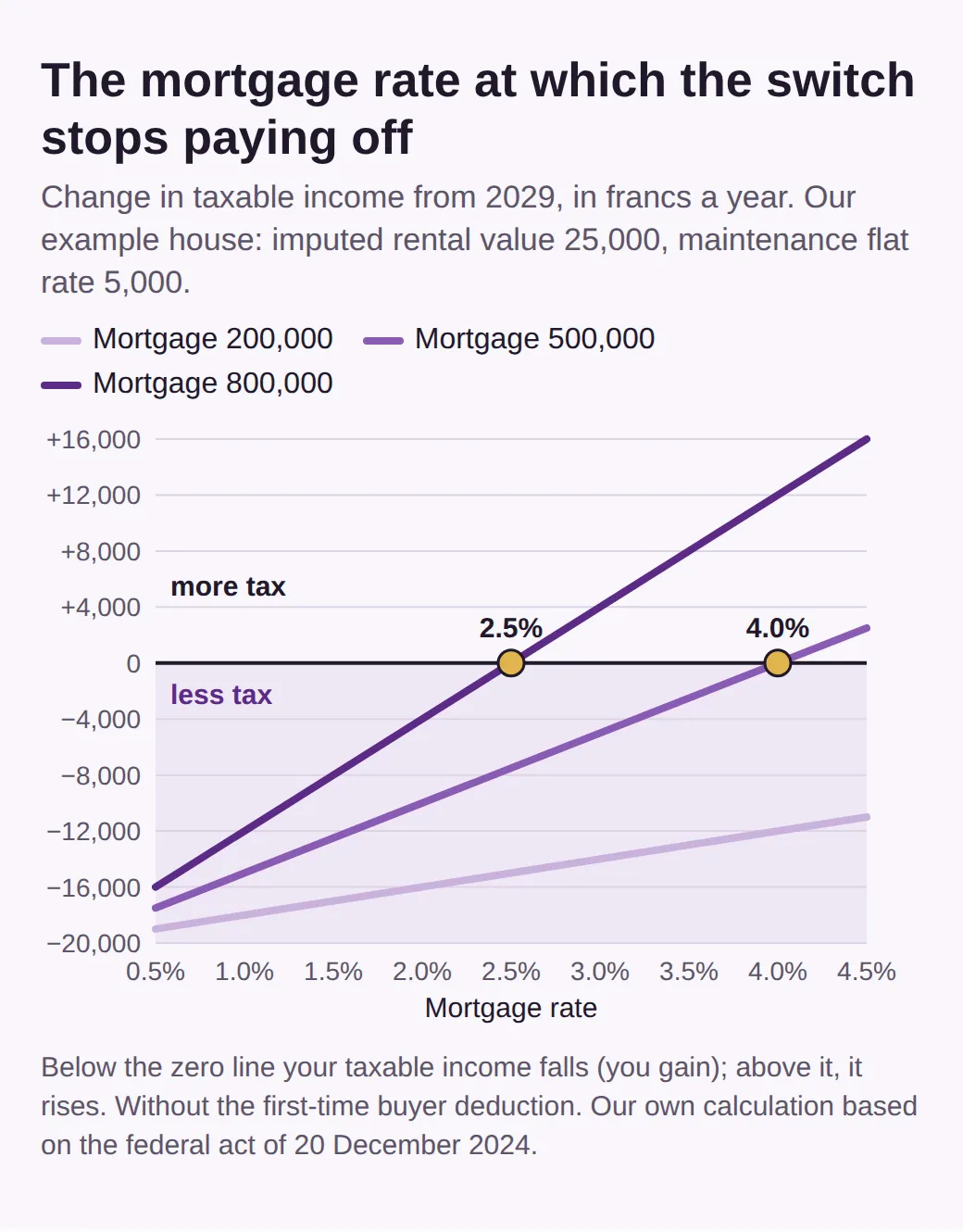
For all owners together, the official estimate shows the same picture. At an average mortgage rate of 1.5 percent, the federal government expects tax revenue for the Confederation, cantons and communes to fall by around CHF 1.8 billion, according to the FDF's questions and answers (in German). From about 3 percent, they would together take in more than under today's system. The FTA has also looked at who is affected: younger owners are worse off than older ones even at lower rates, and owners on low incomes get more relief on average in franc terms. The analysis, though, is based only on federal tax and on data from four cantons for tax year 2019.
One case is missing from the table, and it can make a big difference: the year of a major renovation. If you replace a roof for CHF 40,000 in 2028, you can deduct those costs instead of the flat rate. In 2029 the same bill is worth nothing for tax purposes. At our assumed marginal rate, that is a difference of around CHF 10,000 for the same work. If you are buying now, though, you get something the three households above do not.
The first-time buyer deduction: how much and for how long
If you buy a home in Switzerland for the first time and live in it permanently and exclusively yourself, you can still deduct interest, for ten years and up to a ceiling that falls every year.
In the first year, under Art. 33a of the amended Federal Act on Direct Federal Taxation, the ceiling is CHF 10,000 for married couples and CHF 5,000 for everyone else. After that it drops each year by 10 percent of the maximum, so for married couples to 9,000, then 8,000 and so on, until the deduction ends after ten years. Only the interest on that home can be deducted.
This matters if you have already bought: the deduction also applies to purchases before 2029. If you bought your first home no more than ten years before 1 January 2029, you get it for the years that are left. The FDF explains this in its questions and answers with an example: if you bought three years before the start, you can claim the deduction for another seven years afterwards, and the amount follows the purchase date, not the start of the reform.
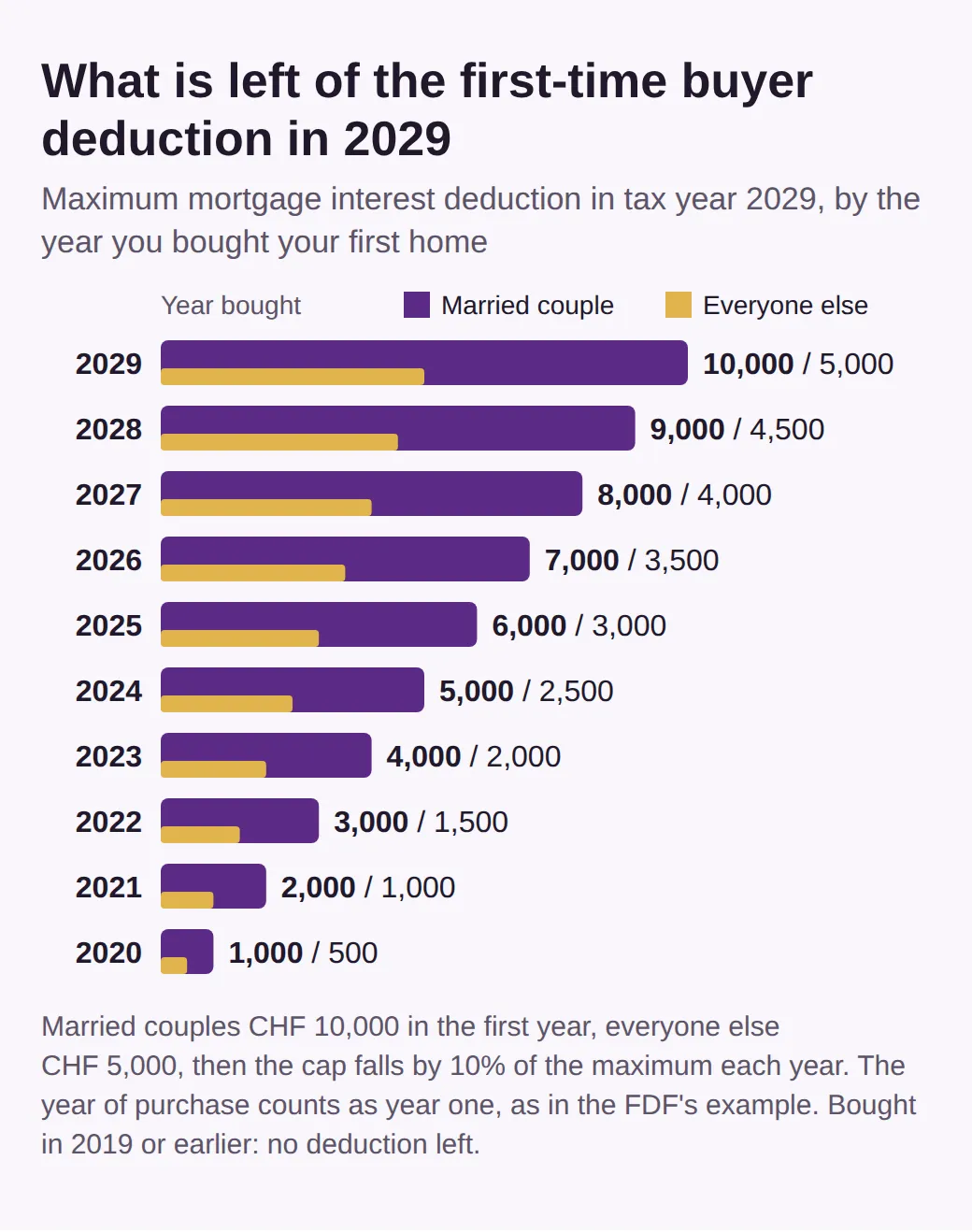
On this reading the year of purchase counts as year one. A married couple buying in 2026 can therefore deduct at most CHF 7,000 in 2029, CHF 4,000 in 2032, and nothing from 2036. If you bought in 2020, you get just CHF 1,000 in 2029. How the years are counted has not been fully settled. According to the FTA, a working group of federal and cantonal officials was to collect open questions of interpretation in the first half of 2026 and draft the implementing rules, which would then go out for consultation. By mid-October 2026 we had not found a published draft.
Let's run the numbers for our third couple again, this time as a married couple buying their first home in spring 2028. In 2029, at 1.5 percent, they pay CHF 12,000 in interest and, following the FDF's example, can deduct CHF 9,000 of it. Their taxable income then falls not by CHF 8,000 but by CHF 17,000 compared with today. The advantage shrinks year by year, and after ten years they are in the same position as everyone else.
The deduction ends sooner if you sell or use the home differently, for example by renting it out. If you buy a new home in Switzerland to live in yourself within a reasonable time, it carries on for the remaining years. The sums look quite different for anyone who rents out a flat.
Landlords: a proportional interest deduction
If you own a rented property, you can still deduct interest, but only the share that your rented property makes up of your total assets. The FDF calls this the restrictive proportional method (quotal-restriktive Methode).
The FTA's fact sheet on the new interest rules works it through like this. Someone owns a home worth CHF 800,000, a holiday flat for their own use worth 300,000 and a rented flat worth 800,000, and has 200,000 in the bank. They have CHF 500,000 of debt at 2 percent, so CHF 10,000 in interest. The rented flat accounts for 800,000 of their 2,100,000 francs in assets, which is 38.1 percent. They can deduct CHF 3,810. Which property the mortgage is secured on makes no difference.
For private landlords this usually means a smaller interest deduction than today. You can, however, still deduct the full maintenance costs of a rented flat, or the flat rate if you prefer, because you also pay tax on the rent. But here too you lose the deduction for energy-saving investments for federal tax. For holiday homes, a new tax comes into play as well.
Second homes: the cantons' new tax
For second homes that you mainly use yourself, the imputed rental value goes too. In its place, the cantons may levy a special property tax. The new provision in the Federal Constitution, Art. 127 para. 2bis, expressly allows them to depart from the usual principles of taxation when they do.
Each canton decides whether and how to do this, and it may only tax homes on its own territory. According to the FDF, it all depends on how the home is used. If you use it entirely yourself, there is no interest deduction and the canton may levy the special tax. If you rent it out in part, the rented share can count towards the interest deduction, and the special tax remains possible. If you rent it out in full, you pay tax on the rent and the special tax does not apply.
For a concrete example, look at Graubünden: on 27 August 2026 it opened a consultation (in German). The canton wants to levy 1.5 per mille, or 0.15 percent, on the wealth tax value of a second home used mainly by its owner. Communes and churches would be allowed to bring in such a tax of their own and set its rate themselves. For a holiday flat with a wealth tax value of CHF 600,000, that would be CHF 900 a year for the canton, plus any share for the commune. Without the imputed rental value on second homes, Graubünden expects to lose CHF 40.5 million in tax a year at cantonal level and CHF 32.5 million at communal level. The consultation runs until 27 November 2026, and because the cantonal constitution is being changed, Graubünden's voters will have the final say.
If you own a holiday flat in a tourist canton, or want to buy one, you should therefore factor in more than just the end of the imputed rental value. You have until the end of 2028 to get your own affairs in order.
What you can do before the end of 2028
Up to and including tax year 2028 the old rules apply, and that is where your room to manoeuvre lies.
Maintenance is the main lever. What you spend until the end of 2028 on work that maintains your home's value, such as new windows or a like-for-like new heating system, you can still deduct; from 2029 you cannot. If you are planning larger work in the next few years anyway, it pays to look at the date on the invoice. For energy-saving renovations, whether the deduction still applies after 2028 depends on your canton.
On the mortgage side, the switch removes the tax incentive to keep debt high. The FDF expects this to strengthen the incentive to pay debt off faster. Whether that works for you depends on what your money would earn elsewhere and how much cash you want to keep on hand. Base the decision on the rate you expect after 2029, not today's.
And if you are buying right now, bear in mind that every year before 2029 comes off the first-time buyer deduction. A purchase in 2027 brings at most CHF 8,000 of deduction in 2029, a purchase in 2029 the full 10,000. On the other hand, if you buy earlier, you still deduct your interest under the old rules until 2028. At our assumed marginal rate that is a few hundred francs a year, no reason to let the right house go. You can find current listings from all over Switzerland on our home page. For your own case, your canton's tax office is the right place to ask: it, not the FTA, assesses your taxes, and it can tell you how far your canton has got with the changes.
Common questions
Does the abolition of the imputed rental value affect tenants?
Mostly not. It affects tenants who have debts, such as a consumer loan or a Lombard loan against securities. From 2029 that interest is no longer deductible unless you own a rented property. According to the FDF, there are not many such households compared with all tenant households.
Can I claim the first-time buyer deduction on a holiday home?
No. The law requires you to buy a property in Switzerland for the first time and to live in it permanently and exclusively yourself. A holiday home does not meet that test, even if it is the first property you own.
How is a second home that I partly rent out taxed after 2029?
According to the FDF, the rented share can count towards the interest deduction, and the canton may still levy the new special tax if you mainly use the home yourself. The law does not say clearly how the rented share is worked out; possible bases include the number of days it is rented or the rental income. If you rent the home out in full, you pay tax on the rent and no special tax.
Can I still choose between the flat rate and actual maintenance costs until 2028?
Yes. The old system applies up to and including tax year 2028, and both federal and cantonal tax let you choose again every year and for each property. In a year with major work you deduct the actual costs, in the other years the flat rate.
What happens to the first-time buyer deduction if I sell my home and buy another one?
The deduction stops from the tax year after the sale. If you buy a new home in Switzerland to live in yourself within a reasonable time, it carries on for the years that are left, but it does not start again from the beginning. If too much time passes between the sale and the purchase, it lapses for good.