Swiss mortgage affordability: how banks calculate it in 2026

The calculation in short
Banks test affordability like this: 5% interest on the whole mortgage, plus the yearly amortisation and 1% of the purchase price for running costs. That total may be no more than one third of your gross income. For an apartment costing CHF 900,000 with 20% equity, you therefore need an income of CHF 159,000 a year.
You'll find this rule of thumb everywhere. What's usually missing: it isn't in any law, every bank sets its own figures, and the bank runs the numbers again when you retire, if not before. We work through the affordability test step by step, then backwards from your income to the price you can pay, and show what counts as income and what doesn't. It's based on the guidelines of the Swiss Bankers Association, supervision by FINMA, data from the Swiss National Bank and the published practice of several banks.
How to calculate affordability in four steps
The calculation needs only the purchase price, your equity and your income. Take a couple who want to buy an apartment for CHF 900,000. They bring CHF 180,000 of equity, which is 20%, and need a mortgage of CHF 720,000. Together they earn CHF 165,000 gross a year.
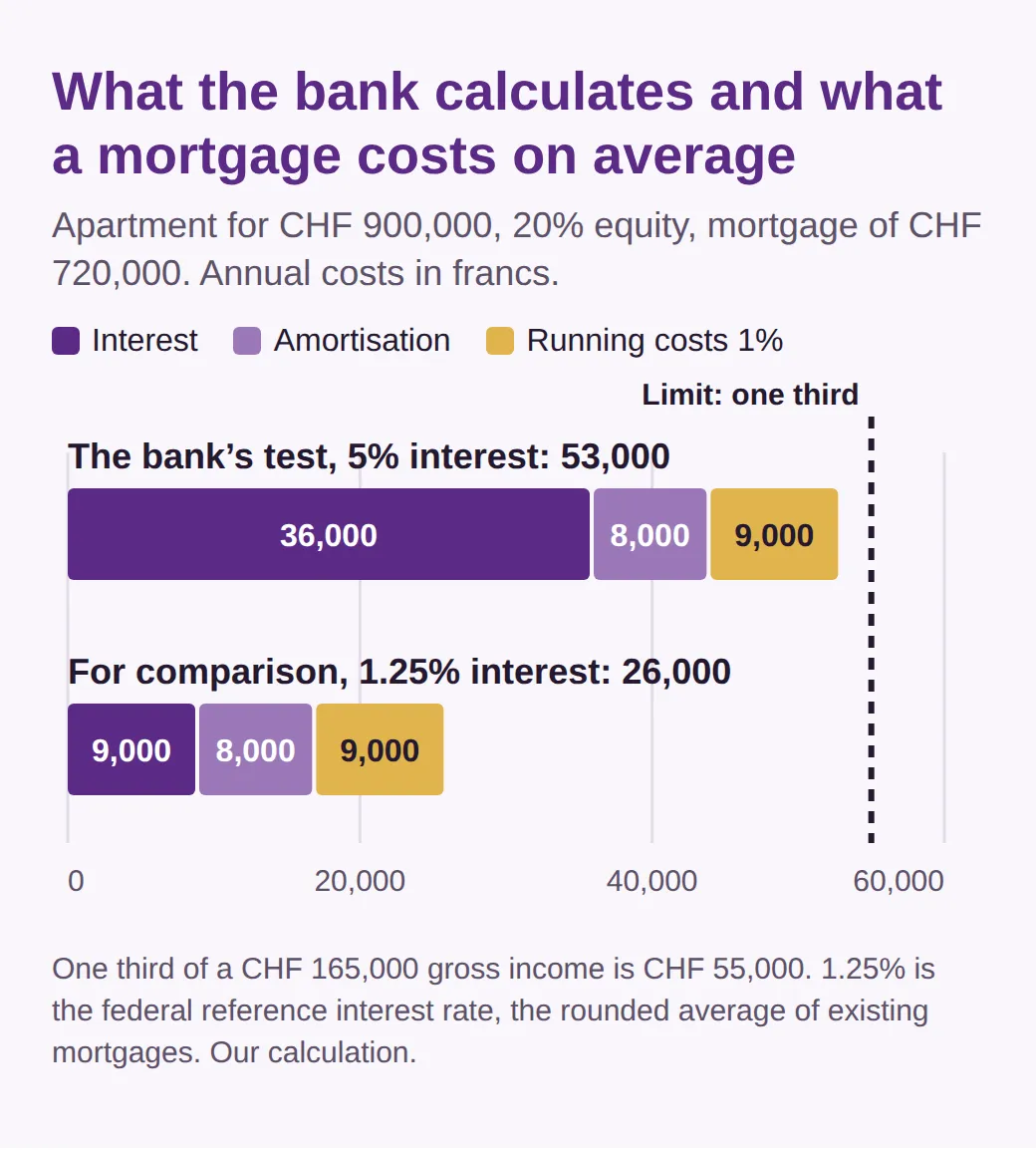
- Interest: 5% on the whole mortgage, so CHF 36,000. This is called the imputed interest rate: it isn't the rate in your contract but a cautious figure used for the test.
- Amortisation: the part of the mortgage above two thirds of the value has to be paid off within 15 years. Two thirds of 900,000 is CHF 600,000; the remaining CHF 120,000 divided by 15 gives CHF 8,000 a year.
- Running costs: 1% of the purchase price, so CHF 9,000. This covers ongoing costs such as heating, electricity, water, insurance and repairs.
- Comparison: 36,000 plus 8,000 plus 9,000 makes CHF 53,000. Divided by an income of CHF 165,000, that's 32.1%. The one-third limit is met, but only just.
The result is called the affordability ratio. UBS, for example, says on its page on affordability that the affordability ratio must not exceed 33%. If the couple earned CHF 150,000, they'd be at 35.3% and wouldn't get this mortgage from a bank with that limit.
One mix-up is common: the 1% running costs have nothing to do with the one-off costs of buying. Property transfer tax, notary and land registry fees are paid once, when you buy. The affordability test only asks whether you can carry the ongoing costs year after year. Where the 5% and the one third come from in the first place is the next question.
Who sets the figures
The figures 5%, 1% and one third appear in no law and no ordinance. They're bank practice, and each bank may set them differently.
What is binding are the Swiss Bankers Association's guidelines on loans secured by property (English overview; the guidelines themselves are in German), whose current version has applied since 1 January 2025. They say affordability must hold in the long term and rest on sustainable income and expenses. Each bank sets the imputed interest rate and the maximum ratio of costs to income itself, in internal rules. The guidelines give no number, only that the rate must be set cautiously and may be based on long-term averages.
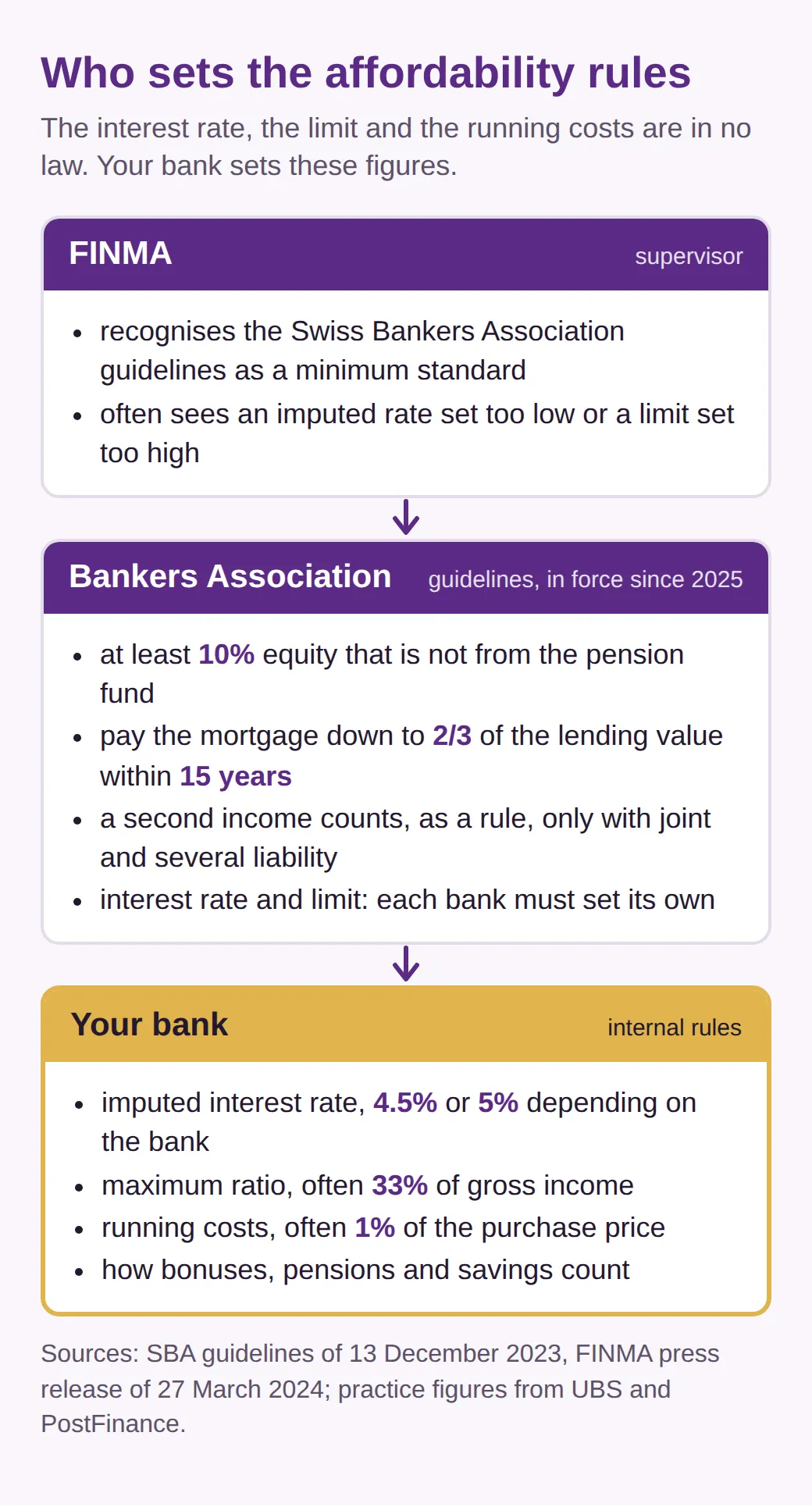
Only two things are fixed in numbers, in the minimum requirements for mortgage financing (PDF in German): at least 10% equity that doesn't come from the pension fund, and amortisation down to two thirds within 15 years. How to put the equity together is covered in our post on equity for buying a home.
In practice, though, the banks' figures are not far apart. UBS says that 4.5% or 5% is used, depending on the bank. PostFinance works with 5%, 1% running costs and one third of gross income. FINMA's findings show that banks do use this leeway: in its press release of 27 March 2024, FINMA says it is increasingly seeing the imputed interest rate set too low or the affordability limit too high. Quite a few banks also grant too many loans outside their own lending criteria. So why 5% at all, when a mortgage costs much less?
Why 5% when a mortgage costs less
The 5% is a stress test. The bank wants to know whether you could keep your home even if rates rose sharply for the whole term.
The mortgage reference interest rate published by the Federal Office for Housing (page in German) shows how big the gap is. It's based on the average rate banks charge on their existing mortgages, rounded to a quarter point. It has stood at 1.25% since 2 September 2025, and the office confirmed it on 1 September 2026. Run our example at that rate and the mortgage costs CHF 9,000 in interest a year instead of CHF 36,000.
Two things are worth knowing when you compare. First, amortisation isn't an expense like interest: you're paying off debt, and the money stays in the apartment as equity. Second, the gap between 1.25% and 5% isn't a cushion to plan your budget around. It's the reason the bank won't lend you more.
The Swiss National Bank measures how much cushion new mortgages really have. According to its Financial Stability Report 2026, for a quarter of new mortgages on owner-occupied homes in 2025, the loan was at least 6.9 times the household's annual net income. For loans like these, by the SNB's calculation, one third of income is already used up at an interest rate of 3.5%, not only at 5%. The SNB works with a narrow, standardised definition of income. Banks often count more income, and the SNB finds that households with financial reserves are much less at risk. Still, the finding fits FINMA's warning: not every loan is calculated as strictly as the rule of thumb suggests. For you as a buyer, the reverse question matters most: how much can you afford on your income?
How much home can you afford on your income?
With 20% equity and a 5% imputed rate, you can spend about 5.7 times your gross income on a home. If the bank works with 4.5%, it's about 6.1 times.
This multiple follows directly from the four steps. With 20% equity, interest, amortisation and running costs together come to about 5.9% of the purchase price a year. Your income must therefore be at least three times that, just under 17.7% of the price. Worked backwards, that gives these maximum prices:
| Gross income | Max. price at 5% | Equity needed | Max. price at 4.5% |
|---|---|---|---|
| 100,000 | 566,000 | 113,000 | 607,000 |
| 130,000 | 736,000 | 147,000 | 789,000 |
| 160,000 | 906,000 | 181,000 | 972,000 |
| 200,000 | 1,132,000 | 226,000 | 1,215,000 |
| 250,000 | 1,415,000 | 283,000 | 1,518,000 |
All amounts in francs, rounded, with 20% equity, amortisation to two thirds over 15 years and 1% running costs. At the higher price in the last column you also need 20% of that price as equity. The quickest way to see how far your maximum price goes is with real listings, for example apartments for sale in the canton of Aargau:
More equity helps twice: the mortgage gets smaller, and once your equity reaches one third, the mandatory amortisation disappears altogether. With 30% equity, the multiple at 5% rises to about 7.1 times income. Someone earning CHF 160,000 could then pay up to around CHF 1.13 million, but would need CHF 339,000 of equity for it. That's why your savings, not affordability, are often the tighter limit. When it comes to amortisation, you have more leeway than the rule of thumb suggests.
Amortisation: what's required and what isn't
All that's required is to bring the mortgage down to two thirds of the lending value within 15 years. The guidelines don't require the rest, the first mortgage, to be repaid.
The lending value is the value the bank puts on your property. It can be lower than the purchase price; under the minimum requirements, you must pay the difference entirely from equity that doesn't come from the pension fund. Amortisation must be linear, meaning the same amount each year, and must start no later than twelve months after the loan is paid out.
You can amortise directly or indirectly. Directly means you pay part of the loan back to the bank each year, so the mortgage, and with it the interest, goes down. Indirectly means you pay into pillar 3a and pledge the balance to the bank; the mortgage stays the same until you use the money at the end. The guidelines expressly allow this. According to the Federal Social Insurance Office (page in German), employees with a pension fund can pay at most CHF 7,258 into pillar 3a in 2026; from 1 January 2027 the limit is CHF 7,373 (Federal Council announcement in German). For our example with CHF 8,000 of amortisation, a single 3a account doesn't quite cover it in either year; if both partners pay in and the bank accepts both accounts as collateral, it works.
One rule you often read isn't in the guidelines in that form: that the second mortgage must be paid off by retirement at the latest. The minimum requirements mention only the 15 years. Many banks still ask for it, including Raiffeisen (page in German) and PostFinance. If you buy at 55, you then have about 10 years rather than 15, and the yearly amortisation rises accordingly. That brings us to income, the other side of the calculation.
What counts as income and what gets deducted
Only income that's sustainable counts, meaning income that is reasonably certain over the medium term. What that means in detail is, again, up to each bank.
One rule is decisive for couples. Under the Swiss Bankers Association's guidelines, a second income can, as a rule, only be counted if there's joint and several liability. That means both of you sign the loan agreement, and the bank can claim the full amount from either of you. If in our example one partner earns CHF 95,000 and the other CHF 70,000, and only the first signs, the ratio jumps from 32.1% to 55.8%. The same apartment would no longer be affordable.
Even between joint borrowers, not every franc counts the same. UBS gives three examples from practice: some banks count bonuses only partly or not at all, some take into account that working hours, and with them family income, might change when a child is born, and ongoing obligations such as leasing contracts are deducted from income. The guidelines add maintenance payments and instalments on personal loans, and they let the bank choose whether to deduct such payments from income or add them to costs. A car lease of CHF 600 a month comes to CHF 7,200 a year. If the bank deducts it from income, as UBS describes, our couple ends up at 33.6%; if it counts it as a cost, it's 36.5%. Either way, they miss the limit.
If a large part of your pay is variable, or you're self-employed, ask the bank how it counts that income before you go to viewings. The guidelines only require that the bank sets this in its rules, not how. And at retirement your income changes anyway, at which point the bank recalculates.
The second test: after retirement
Banks want to know whether you can still afford your home on your retirement income. They keep calculating with 5% interest, even though income usually falls sharply.
PostFinance says an imputed rate of 5% is applied after retirement too. Raiffeisen works with a limit of 38% of available income for that period and doesn't require the first mortgage to be repaid as long as affordability after retirement holds.
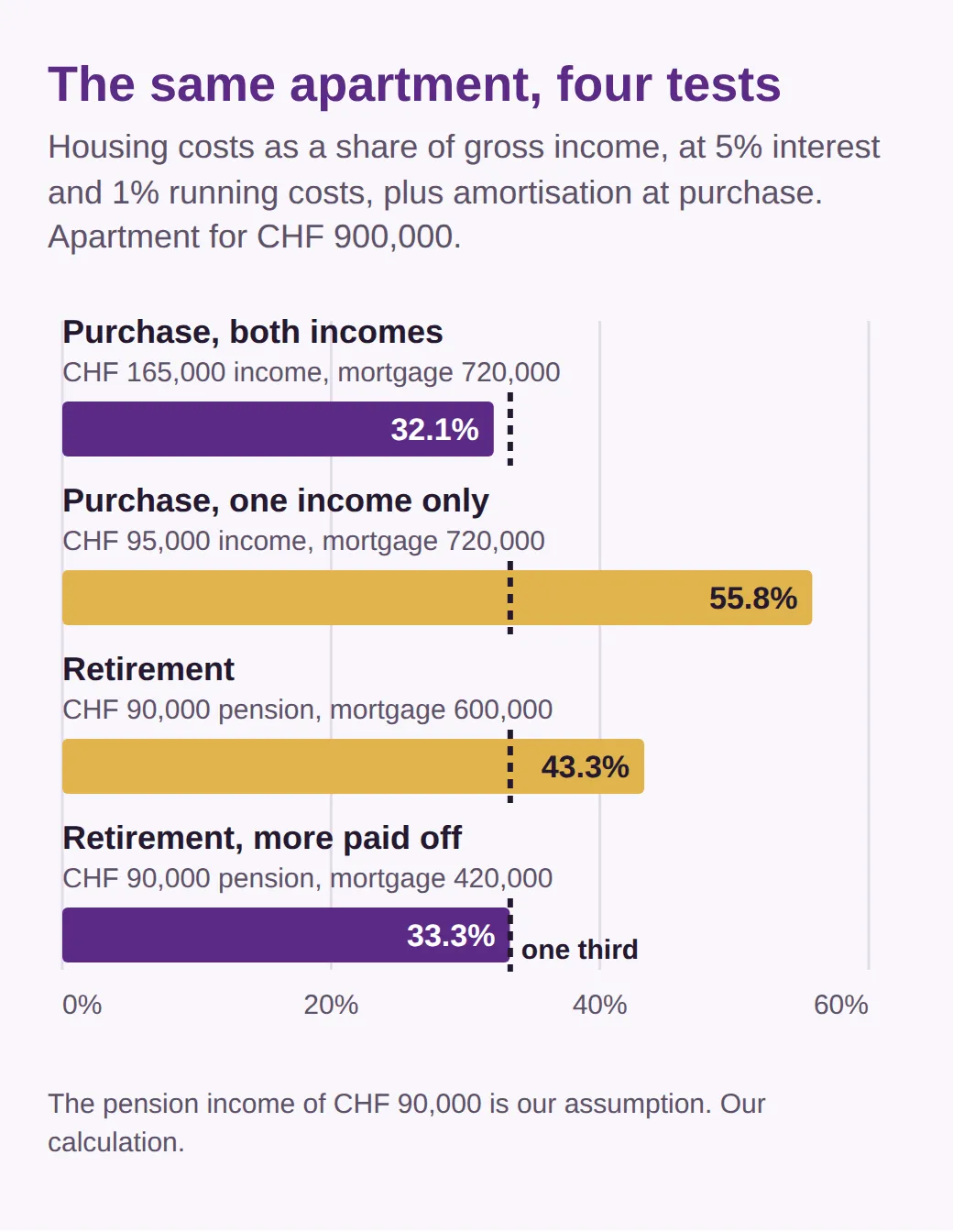
Suppose our couple has paid the mortgage down to CHF 600,000 by retirement, and their pensions from OASI (AHV) and the pension fund come to CHF 90,000 a year together. The bank counts CHF 30,000 in interest and CHF 9,000 in running costs, CHF 39,000 in total. That's 43.3% of income. To get to one third, the mortgage would have to fall to CHF 420,000, so the couple would need to repay another CHF 180,000.
This is where savings help. According to PostFinance, banks can count liquid assets such as account balances or securities as notional income, at about 4% to 5% of the amount. At 5%, CHF 150,000 in an account or a securities portfolio counts like CHF 7,500 of extra income. In our example, the income counted would rise to CHF 97,500, and only CHF 130,000 rather than CHF 180,000 would need to be repaid.
Plan this early, not at 64. If you already amortise indirectly through pillar 3a, you'll have money you can put in when you retire. If you use pension fund money for the mortgage, on the other hand, you shrink your pension, as UBS warns, and with it exactly the income the bank tests in retirement. That leaves the question of what to do if the numbers fall just short when you buy.
When the numbers fall just short
If your ratio is slightly above one third, you have four levers: more equity, a lower price, a second income as a joint borrower, or a bank with different figures. For a lower price, it pays to search more widely than planned, by area and type of property, for example houses for sale in the canton of Lucerne:
Every bank sets its own imputed rate, and in our table, 4.5% instead of 5% already allows a purchase price about 7% higher. So it's worth getting several offers and asking explicitly about the rate and the limit in the affordability test, not only about the rate in the contract.
Then there's the exception. In justified cases, banks may grant loans outside their own rules, known as exceptions to policy. The bank has to document and monitor them, and FINMA sees too many of them. For you, that means a bank waving through a ratio of 36% has its reasons, but in the end it's you who carries the risk of rising rates. With a SARON mortgage in particular, whose rate keeps adjusting to the market, a rise reaches your budget quickly.
So before your first viewing, work out your own maximum price: at 5%, with your equity and only the income you'll still be sure of in five years. If the home you want is below it, you'll negotiate more calmly. What changes for owners' taxes from 2029 is covered in our post on the abolition of the imputed rental value.
Common questions
Does the bank check mortgage affordability again after I buy?
The bank reviews your loan at intervals it sets itself, and when something happens that affects your ability to pay. If you renew a fixed-rate mortgage for the same or a lower amount, the Swiss Bankers Association's guidelines say affordability does not have to be reassessed. If you want to increase the mortgage, it takes a new credit decision with a full affordability check.
Will a new bank recalculate affordability if I switch my mortgage?
Yes. For the new bank, taking over your mortgage is new business, and it assesses it like any new loan. If you earn less than when you bought, or have retired, a switch can therefore fail on affordability even though your current bank would renew.
Can I calculate mortgage affordability with my net salary?
Banks work with your gross salary; at PostFinance, for example, the one-third limit refers to gross income. If you only have your net pay to hand for a rough check, you can follow the Swiss National Bank: in its analyses it uses 38% of net income as a stand-in for one third of gross income. For the credit decision, though, the bank's own calculation is what counts.
Are online mortgage affordability calculators binding?
Not at all. A calculator applies the rule of thumb with fixed figures. What matters are the internal rules of the bank that assesses your loan: its imputed interest rate, its maximum ratio and how it counts bonuses, a second income and savings.
More from the blog
All posts
Condominium renovation fund in Switzerland: how much to pay?
Renovation fund in a Swiss condominium: recommended contributions, a worked example in francs, the rules, the owners' meeting and the 2029 tax change.

Reservation agreement in Switzerland: is your deposit lost?
Without a notary, a Swiss property reservation agreement is void. What the top court ruled on deposits, how to pay safely and the steps to the land register.

Buying a house in Switzerland as a foreigner: 2026 rules
Who can buy property without authorisation: EU/EFTA, B, C, L and G permits, non-EU buyers, holiday homes, land, moving away and the planned Lex Koller reform.