Condominium renovation fund in Switzerland: how much to pay?

The rule of thumb
The law does not require a renovation fund and sets no amount. Industry associations recommend paying in 0.2 to 1.2 percent of the building insurance value each year. For a fund that pays only for necessary work, the Federal Council calls 0.4 percent a good guide, until the fund reaches 6 percent of that value. With an insurance value of CHF 5 million and a value quota of 100/1000, that is CHF 2,000 a year for you.
That sounds like little, and that is exactly the problem. Many communities of owners save less than their building will need later, and only notice when the roof is due. We show what the law says and what it leaves out, work through the fund for an example building in francs and explain who decides what at the owners' meeting. There are also two changes you should know about: from 2029, contributions for an apartment you live in yourself are no longer tax-deductible, and the Federal Council wants to let owners go to court to get a fund set up. Our sources are the Swiss Civil Code, the Federal Council's dispatch of 13 May 2026, a Federal Supreme Court ruling and the practice of cantonal tax offices.
What the renovation fund is and who owns it
The renovation fund (Erneuerungsfonds) is money the community of owners puts aside year after year to pay later for major work on the common parts of the building. That means the roof, facade, lift, heating or stairwell, not your kitchen.
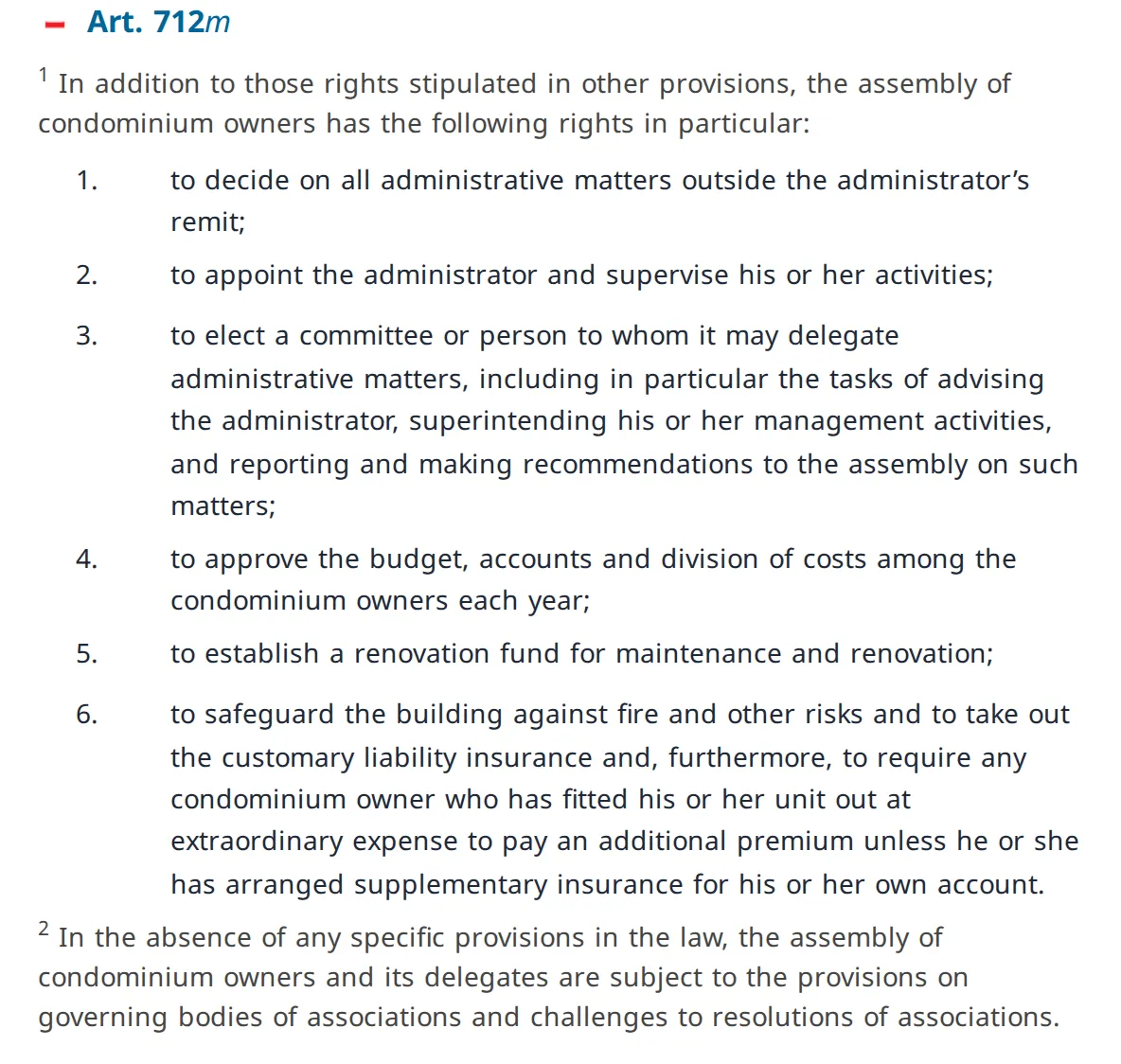
The Civil Code mentions the fund in only two places. Art. 712l CC counts it among the assets the community holds in its own name. And Art. 712m lists deciding on a renovation fund among the powers of the owners' assembly. That is all the law says: no duty, no amount, no ceiling.
Who the money belongs to was settled by the Federal Supreme Court in ruling 9C_391/2023 of 5 January 2024. The community controls the fund, but legally it still belongs to the individual owners in proportion to their shares. You can neither withdraw your share nor sell it separately. It is tied to the apartment and passes with it to the next owner. That is also why you declare your share as assets in your tax return.
How much money should be in the pot is something the law does not say. For that, there are recommendations.
How much should go in?
The recommendations range from 0.2 to 1.2 percent of the building insurance value a year. The building insurance value (Gebäudeversicherungswert) is the amount the whole building is insured for against fire and natural hazards. You will find it in the community's policy or in the notice from the cantonal building insurer.
The Federal Council's dispatch (in German) on the reform of condominium law lists the recommendations of the associations. According to the dispatch, HEV Schweiz, the Swiss homeowners' association, advises 0.9 to 1.2 percent, and USPI, the association of real estate professionals in Vaud, 0.2 percent. The homeowners' association of the Winterthur region (in German) recommends more than 1 percent on its own website. The Swiss association of condominium owners (in German) recommends at least 0.4 percent for as long as the fund is below 6 percent of the insurance value. The Federal Council calls this 0.4 percent a good guide where a court orders a fund that pays only for necessary work. For the ceiling of the fund, the dispatch gives 2 to 10 percent of the insurance value.
Tax offices have a view too, because contributions are currently deductible. The Thurgau Cantonal Tax Administration (in German) considers contributions of 0.2 to 1 percent customary. As a rule the fund should not exceed 10 percent, and the tax office reserves the right to examine it in the assessment.
Our example building shows what this means in francs: ten apartments, insured for CHF 5 million. Your apartment has a value quota (Wertquote) of 100/1000, so one tenth of the whole. Under Art. 712h, everyone pays according to their value quota, and the fund is split the same way.
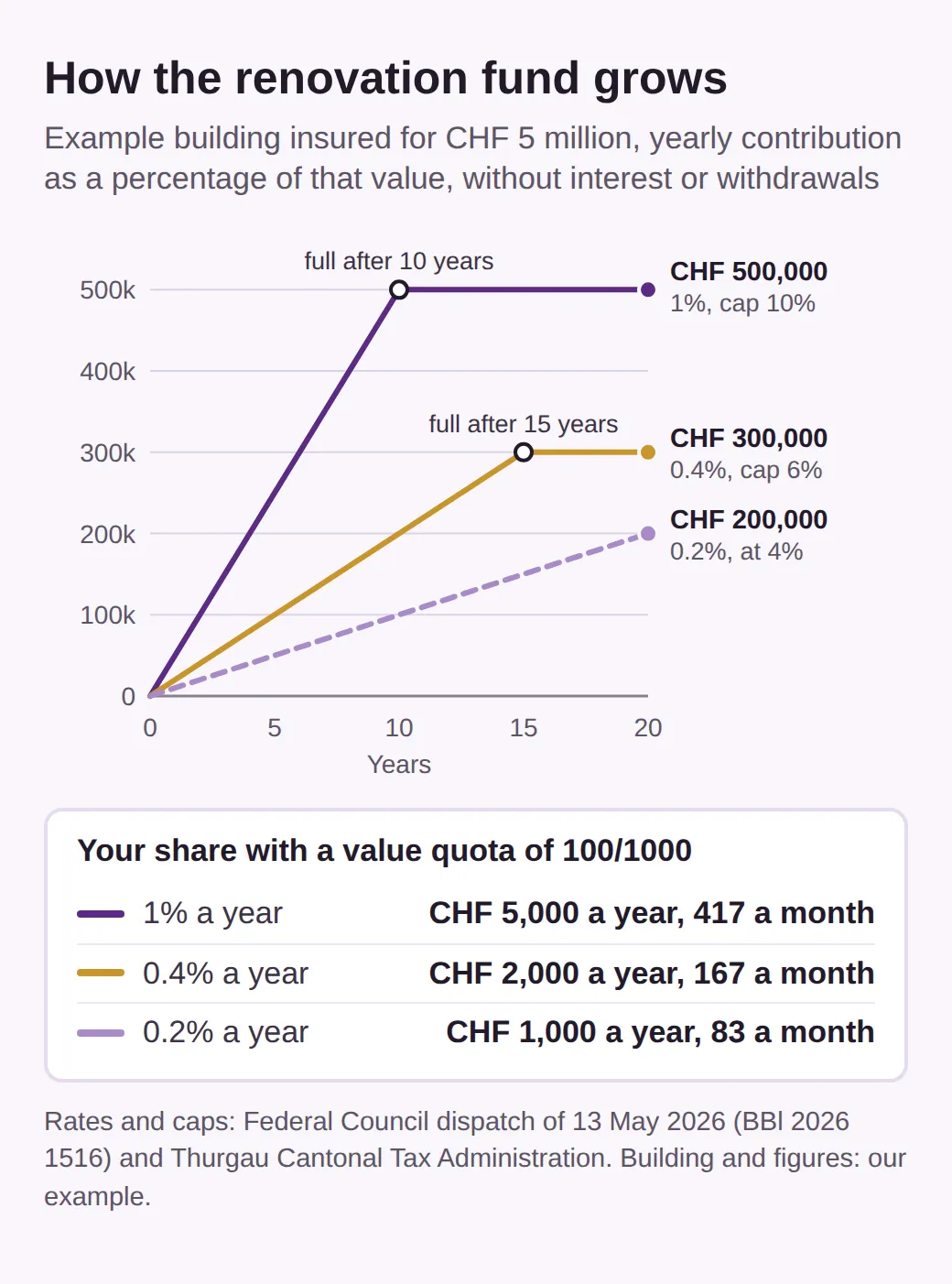
At 0.4 percent the community pays in CHF 20,000 a year, and your share is CHF 2,000, or about CHF 167 a month. After 15 years the fund holds CHF 300,000 and reaches the 6 percent limit. At 1 percent you would pay CHF 417 a month, and the fund would be full at CHF 500,000 after ten years. At 0.2 percent you pay CHF 83 a month, and after 20 years the fund holds CHF 200,000.
Which rate suits your building depends on its age, condition and features. A building with a flat roof, a lift and an underground car park needs more than a plain one without a lift, and a building from the 1970s more than a new one. And a fund set up just before a major renovation can't close the gap any more: even for a fund ordered by a court, the Federal Council considers very high catch-up contributions inappropriate. Two studies show how often funds fall short.
Why so many funds are too small
Most communities have a fund, but it is often not enough. A 2010 study by the Lucerne University of Applied Sciences and Arts (HSLU) for the Federal Office for Housing, cited by the Federal Council in its dispatch, looked at condominiums in the Lucerne area. 84 percent of the communities had a renovation fund, and three quarters thought their contributions were right. In reality, only a quarter to a half of the funds could pay for the renovations that lay ahead.
A report by the Swiss Federal Office of Energy (in German) from 2023 on a follow-up project by the university gives the reason. According to the Lucerne surveys, communities put aside 0.25 percent of the insurance value a year on average. Only ten percent reached the 0.8 percent that the report gives as a guide just for keeping up the value of the common parts. For your own rooms it adds another 1.1 percent, which you save privately. For an apartment with an insurance value of CHF 600,000, that is CHF 400 a month for the fund and CHF 550 for your own interior. The 0.8 percent is within the range the associations recommend, but twice the Federal Council's guide. Together with the private part it comes to almost 2 percent a year. Treat that as an upper estimate, not a norm.
Then there is the age of the buildings. According to the dispatch, a significant share of condominium buildings were built in the 1960s and 1970s. They are now at the age when building services and the envelope need renewing, and many communities run into financing problems as a result. This is not a fringe group: in 2023, 589,170 occupied dwellings were owned as condominiums, 12.3 percent of all occupied dwellings.
A case from Aargau: CHF 400,000 for 1.1 million
The Federal Office of Energy report shows what it looks like when the fund falls short, using a real building. The property in the canton of Aargau has 26 apartments, and the roof had already been renovated. For the facade, lifts, electrical installations and stairwells, the community needed just over CHF 1.1 million. The fund held CHF 400,000.
It closed the gap with two loans: CHF 620,000 from a bank and CHF 100,000 from a private individual. The better-off owners did not want a loan at first. They agreed because renovating in stages would have cost up to CHF 250,000 more. Other communities raise contributions before a renovation or vote for a special levy, if all owners can afford it.
For you as a buyer, this means a special levy like that can hit you too if it was decided before you bought. Under Art. 649a CC, the community's decisions also bind new owners. Where those decisions are written down and how they are made is governed by the regulations and the assembly.
The regulations: the building's constitution
The regulations (Reglement) set out how the community is managed and how the rooms may be used. Every owner can demand that regulations be drawn up and noted in the land register. They are adopted or amended by a majority of the owners who together also hold more than half of the value quotas (Art. 712g para. 3).
The law does not say what goes in them. When you read them before buying, four points matter. First, the fund: is there one, how high are the contributions, is there a ceiling, and what may the money be used for? Second, how costs are split: does everyone pay by value quota, or are there exceptions, for example for the lift that the ground-floor apartment hardly uses? The law requires such cases to be taken into account. Third, the rights to use the garden, parking spaces or attic. Fourth, the majorities: if your building uses different ones from the law, they will be in the regulations or in the deed of constitution.
The fund deserves a second look because the tax office reads it. Contributions are currently deductible only if the regulations provide for the fund and it may be used only for repairing and maintaining the common parts. The Appenzell Innerrhoden Cantonal Tax Administration (in German) says so, and Thurgau takes the same line. If the regulations also open the fund to other purposes, the owners lose the deduction in the year they pay in. Under Thurgau practice, only what the fund actually spends on maintenance is deductible then. The regulations are changed at the owners' assembly.
The owners' assembly: who decides with which majority
The assembly of condominium owners is the community's highest body. Each year it approves the budget, the accounts and the division of costs, appoints and supervises the management company and decides on the fund. Where the law has no special rule, the rules for associations apply (Art. 712m para. 2). But depending on the item, very different majorities are needed.
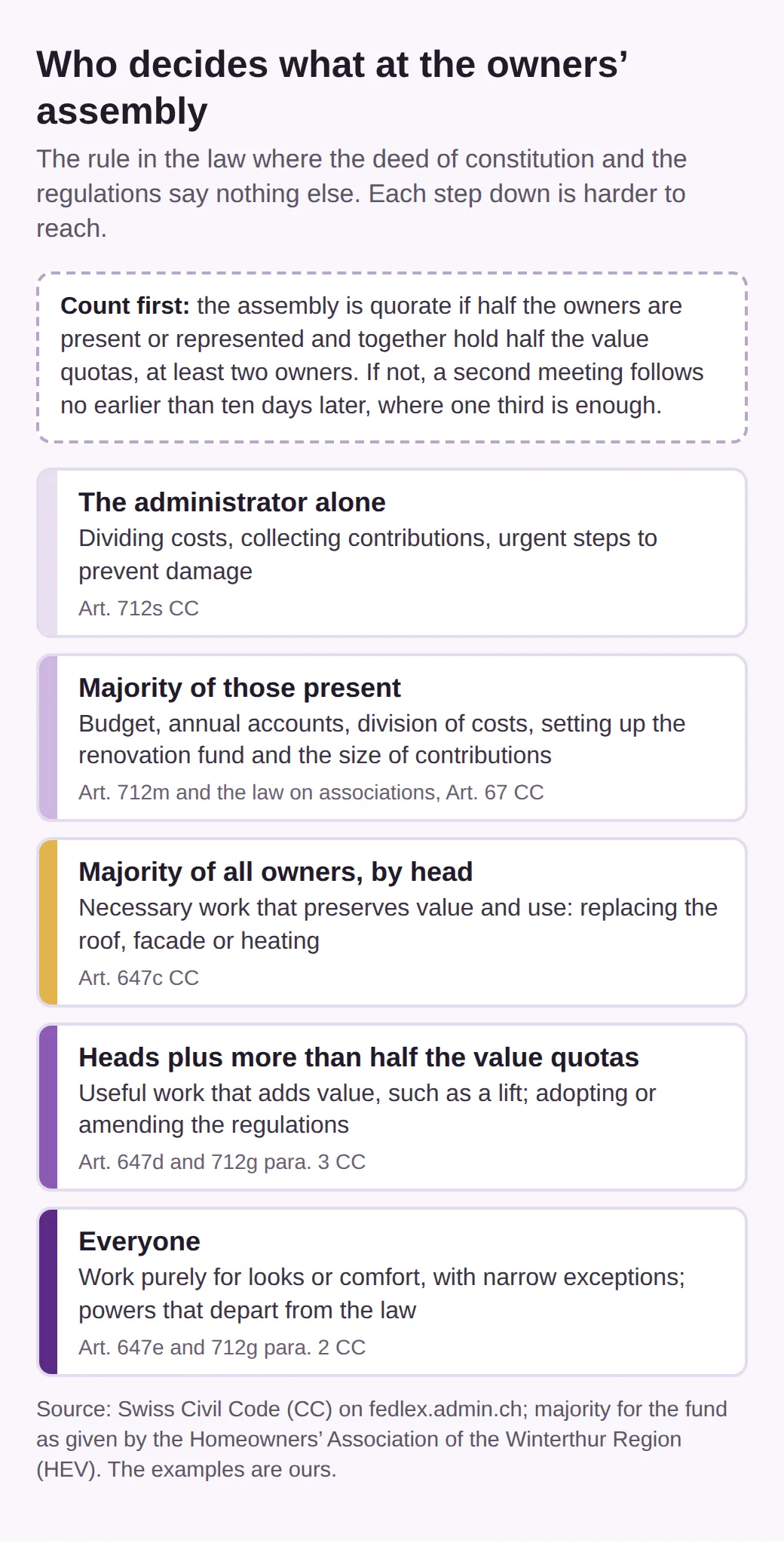
The assembly sets up the fund itself by a majority of those present, unless the regulations say otherwise; the homeowners' association of the Winterthur region reads it the same way. If the fund is already in the regulations, changing it there takes the double majority of heads and value quotas. Spending the money takes the majority that the work in question requires. Necessary work that preserves the building's value and use needs a majority of all owners under Art. 647c, not just of those present. So in a building with ten owners, six must agree, even if only seven turn up. Work that adds value or makes the building more useful also needs a majority of the value quotas (Art. 647d). A well-filled fund makes such majorities easier to find: owners who don't have to put in CHF 30,000 in one go are more willing to say yes.
Before anything can be decided, the assembly has to be quorate. Under Art. 712p, half the owners must be present or represented, together holding half of the value quotas, and at least two owners. If an apartment belongs to several people, such as a married couple, they have one vote between them. And an item that was not properly announced in the invitation can only be decided if the regulations expressly allow it (Art. 67 para. 3). So if you want higher fund contributions, send your motion to the management company in good time before the invitation goes out.
If you disagree with a decision and did not vote for it, you can challenge it in court if it breaches the law or the regulations. The deadline is short: one month after you learn of the decision (Art. 75). What else you can and must do as an individual owner is set out elsewhere in the law.
Your rights and duties as an owner
You don't own any part of the building on your own. Condominium ownership is a co-ownership share in the whole property, combined with the exclusive right to use certain rooms yourself and fit out their interior (Art. 712a). Inside your apartment you are free, as long as you do not obstruct the others and do not damage the common parts or change how they work or look. In return, you must maintain your rooms so that the building stays in good condition.
Your most important duty is to pay. You bear the common costs according to your value quota: maintenance, repairs, management, insurance and the contributions to the fund. If someone does not pay, the community can have a lien registered on their unit for the contributions of the last three years (Art. 712i). The lien attaches to whoever owns the unit. Debts the seller left behind can therefore stick to your new apartment.
Your most important right is one that no regulations can take away: you can demand that the work needed to preserve the building's value and use is carried out, and if necessary have a court order it. If damage is imminent, such as a burst water pipe in the basement, you may act at everyone's expense (Art. 647 para. 2). Until now, you could not take the community to court to get the fund itself. The Federal Council wants to change that.
What the reform plans to change
On 13 May 2026, the Federal Council adopted the dispatch on the reform of condominium law, as the Federal Office of Justice announced (not published in English). Parliament is dealing with it as item of business 26.044, and the National Council will debate it first. As of mid-October 2026 it had not decided anything yet, and the law is subject to an optional referendum. After that, the Federal Council sets the date it comes into force.
The most important change for the fund is Art. 712hbis in the draft (in German). At least two owners can ask a court to set up a fund or adjust an existing one, if the assembly has turned down their motion first. In communities with two or three owners, any owner can sue alone. The court sets the yearly contributions and the term, which may be open-ended, and decides in fast-track summary proceedings. Before the term runs out, the community can only dissolve or change such a fund unanimously. The Federal Council rejects a general duty to have a fund. The National Council had already voted down such a duty on 4 March 2019, by 132 votes to 51.
The draft also changes the assembly. Decisions will only be valid with dated and signed minutes sent to all owners. Abstentions will no longer count towards majorities, unless the regulations say otherwise. An owner who systematically obstructs decisions or repeatedly fails to pay can lose their vote for the next assembly by a decision of all the other owners. If an owner reports a construction defect in the common parts, the management company must call an assembly within three months so the owners can agree how to proceed. And the lien for contributions will be capped at three years' contributions, but in return it will survive a forced sale. A change on the tax side will come sooner than the reform.
Tax: deductible until the end of 2028, then not
Today you deduct your fund contributions as maintenance costs, in the year you pay them. From 2029 that ends for apartments you live in yourself. On 1 April 2026 the Federal Council decided (not published in English) to bring the reform of home ownership taxation into force on 1 January 2029. Along with the imputed rental value, the maintenance deduction goes, and with it the deduction for the fund. What else the reform means is covered in our post on the abolition of the imputed rental value. For rented apartments, the maintenance deduction stays.
The obvious move would be to pay in as much as possible before the end of 2028. The tax administrations of Appenzell Innerrhoden, Appenzell Ausserrhoden, St. Gallen and Thurgau have jointly warned against this. They only accept higher contributions if they stay within the usual range or if a specific, already planned project is documented with cost estimates or project papers. As a rule, they do not accept increases without an objective reason as deductible. So if you are planning a renovation anyway, it pays to document it properly and raise contributions with a stated reason. A pure tax move gets you nothing. We found no such notice from other cantons; if in doubt, ask your tax office.
One trap concerns buyers. In the case before the Federal Supreme Court, a taxpayer bought an apartment in the canton of Bern in 2018 for CHF 860,000 and paid the seller a separate CHF 9,391.40 for the seller's share of the fund. He wanted to deduct the amount as maintenance. The court refused: the payment went to the seller, not into the fund, and is the price of an asset, not maintenance. It noted that a separate price for the fund share is not needed at all under civil law. The parties can simply take the fund into account in the purchase price. And when the fund later pays for work, you don't deduct it a second time, as Thurgau practice states explicitly.
Before you buy: the documents to ask for
Before you buy a condominium apartment, you should know the fund as well as the state of the kitchen. What to look at yourself during the viewing is in our viewing checklist. This section is about the papers you request from the seller or the management company.
You need the regulations, the minutes of the last few assemblies, the latest annual accounts showing the fund balance, and the building insurance value. Divide the fund balance by the insurance value: with CHF 5 million and CHF 150,000 in the fund, that is 3 percent. Then read the minutes to see what work is coming up and whether special levies have already been decided for it. A short request is enough:
Hello, we are interested in apartment no. 4 at Musterstrasse 12. Please send us the regulations, the minutes of the last three owners' assemblies, the 2025 annual accounts with the balance of the renovation fund and the current building insurance value. Please also confirm that no contributions are outstanding for this apartment, and tell us which work or special levies have already been decided.
The confirmation about outstanding contributions matters because of the lien. The answers feed into your sums: a fund well below 1 percent in a 40-year-old building means the community will probably ask for more money soon. That is an argument for a lower price. Also count the monthly fund contribution as part of your running costs. How the bank works out your costs is explained in our post on affordability.
If you already own an apartment, start with the next assembly. Put the fund contributions on the agenda with a written motion, bring the insurance value and a rough list of the work that is due, and propose a rate with a ceiling. Voting for 0.4 instead of 0.2 percent today spares you the special levy later that nobody in your building will want to pay.
Common questions
Do I get my share of the renovation fund back when I sell my apartment?
Not from the community of owners. Your share stays with the apartment and passes to the buyer when you sell. The only way to get it back is through the sale price. A well-stocked fund is therefore a selling point, and an empty one is a reason for a lower price.
Do I have to declare my renovation fund share on my tax return?
Yes. Under the case law of the Federal Supreme Court, condominium owners declare their share of the fund's assets and of its income, such as interest. The management company can tell you your share, and it is often shown in the annual accounts. That figure goes into your tax return.
What happens if a condominium owner does not pay their contributions?
The community can have a lien registered on that owner's unit for the contributions of the last three years. The lien attaches to whoever owns the unit, so it can also hit a buyer if the seller left contributions unpaid. The Federal Council's draft would cap the lien at three years' contributions and protect it better in a forced sale.
Can I renovate my condominium apartment without asking the other owners?
Inside, yes, as long as you do not make it harder for the others to use their rights and do not damage the common parts or change how they work or look. Load-bearing walls, the facade and pipes that also serve others always belong to everyone. Check the deed of constitution and the regulations before you renovate, and ask the management company if you are unsure.
Do I own the garden patio that only I use?
Usually not. A garden or parking space that only you may use is often a common part with an exclusive right of use for you. If that right is set out in the regulations, the assembly cannot change it without your consent. The deed of constitution and the regulations show which applies.
More from the blog
All posts
Buying a house in Switzerland as a foreigner: 2026 rules
Who can buy property without authorisation: EU/EFTA, B, C, L and G permits, non-EU buyers, holiday homes, land, moving away and the planned Lex Koller reform.

Swiss mortgage affordability: how banks calculate it in 2026
5% imputed interest, amortisation and 1% running costs: how Swiss banks calculate mortgage affordability, the income you need and what applies in retirement.

Reservation agreement in Switzerland: is your deposit lost?
Without a notary, a Swiss property reservation agreement is void. What the top court ruled on deposits, how to pay safely and the steps to the land register.