Buying a house in Switzerland as a foreigner: 2026 rules

The short answer
If you live in Switzerland and hold an EU or EFTA passport or a C permit, you buy property just like a Swiss citizen. With a B permit from any other country, you can buy exactly one apartment or house without authorisation, as long as you live in it yourself. Everyone else needs authorisation from the canton, and it is granted almost exclusively for holiday homes.
The rules are set out in the Federal Act on the Acquisition of Immovable Property in Switzerland by Foreign Non-Residents, ANRA for short, better known in Switzerland as the Lex Koller. The Federal Council wants to tighten them: buyers from outside the EU and EFTA with a B permit would need authorisation and would have to sell their home within two years of moving away. The consultation on the draft closed on 15 July 2026; in October 2026 the report on its results was still pending. Until Parliament decides, the current law applies. Below, sorted by permit, you will find what is allowed today, what the cantonal office checks and what the draft would change.
What counts: where you live and your permit, not just your passport
Whether you need authorisation comes down to two questions: where are you from, and where do you really live? The law uses the term "foreign non-residents", and despite the name it does not only mean people who live abroad. Someone who has lived in Zurich for years can be one too.
Under Art. 5 ANRA, EU and EFTA citizens are foreign non-residents as long as they are not lawfully and actually resident in Switzerland. Citizens of all other countries, known as third countries, are foreign non-residents as long as they do not have the right to settle here, in other words as long as they do not hold a C permit. Anyone buying on behalf of a foreign non-resident, such as a trustee, is caught too, even if they are Swiss.
"Actually resident" is meant strictly. According to the questions and answers of the Federal Office of Justice (FOJ), a permit and registration with your municipality are not enough on their own. The authority looks at where you live with your family, where your children go to school, whether you have given up your residence abroad, whether you are fully liable to tax here, where your car is registered and where you do your shopping. The decision rests on all the circumstances taken together.
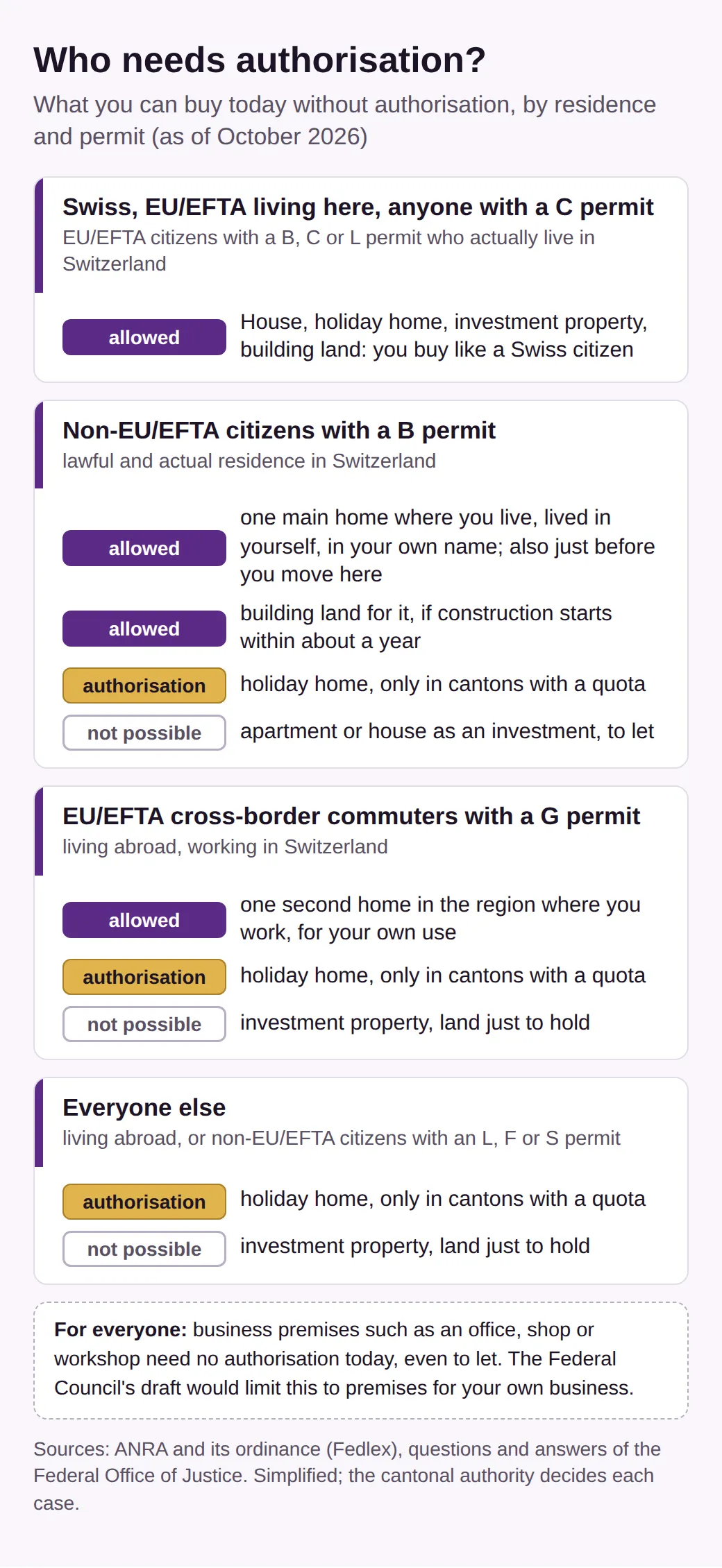
The overview shows the four groups that almost every buyer falls into. The first is the simplest.
EU, EFTA and C permit: buying like a Swiss citizen
If you are from an EU or EFTA country and lawfully and actually live in Switzerland, you are not a foreign non-resident and can buy without any restriction: your own home, a holiday home, an apartment building to let or building land. Under Art. 2 of the ordinance (in German), lawful means that you hold a valid EU/EFTA short-stay, residence or settlement permit. So an L permit is enough too, as long as you really live here.
The same goes for anyone with a C permit, whatever their country. The Canton of Zurich's page on property purchases by foreign non-residents (in German) puts them on an equal footing with Swiss citizens. Swiss dual nationals are never foreign non-residents, even if they live abroad.
For British citizens, the date matters. If you were already living here under the Agreement on the Free Movement of Persons before 2021, you are treated like an EU citizen. If you came later, the rules for third countries apply.
And if you move away again? An EU citizen who returns to their home country becomes a foreign non-resident for any future purchase. According to the FOJ, though, they generally do not have to sell what they bought lawfully before, not even apartment buildings. For citizens of third countries, the route to ownership is narrower.
Non-EU/EFTA with a B permit: one main home
With a B permit from a third country, such as the US, India or China, you can buy an apartment or a detached house without authorisation if it serves as your main home at your lawful and actual place of residence. That is what Art. 2 para. 2 let. b ANRA says.
This exception comes with conditions, and the authorities take them seriously. You buy in your own name, not through a company and not through a share in a housing cooperative. It must be a single residential unit: under FOJ practice, a detached house with a separate granny flat, with its own entrance and kitchen, is generally ruled out. You may not let the home, not even part of it and not even the parking space that comes with it. There is no fixed upper limit on floor area, but the home must not be larger than you need. If the plot is over 3,000 square metres, the land registry office will not register the purchase directly but will send you to the authorisation authority.
Building land is possible if you build your own home on it and, according to the FOJ, start building within about a year. You can also buy before you move to Switzerland, but only as part of the move itself. The Federal Supreme Court allowed this in judgment 2C_876/2011 of 20 March 2012, and the authority imposes conditions to check that you actually come.
The exact permit matters. In Art. 5, the ordinance requires a residence permit issued for taking up residence, and for the land registry it names the B permit explicitly. An L permit held by a third-country national is a short-stay permit and is therefore not enough. Recognised refugees with a B permit can buy a main home; provisionally admitted persons with an F permit cannot. For people from Ukraine with protection status S, buying a main home without authorisation is ruled out according to the FOJ, because the status does not establish lawful residence.
For this group, a main home is the only way to own a home without authorisation. And this is exactly where the Federal Council wants to step in: when you move away.
What happens if you move away?
Today, nothing special. If you move to another municipality or abroad, you can keep the home, let it or use it as a holiday home. You can even buy another main home where you now live without selling the first.
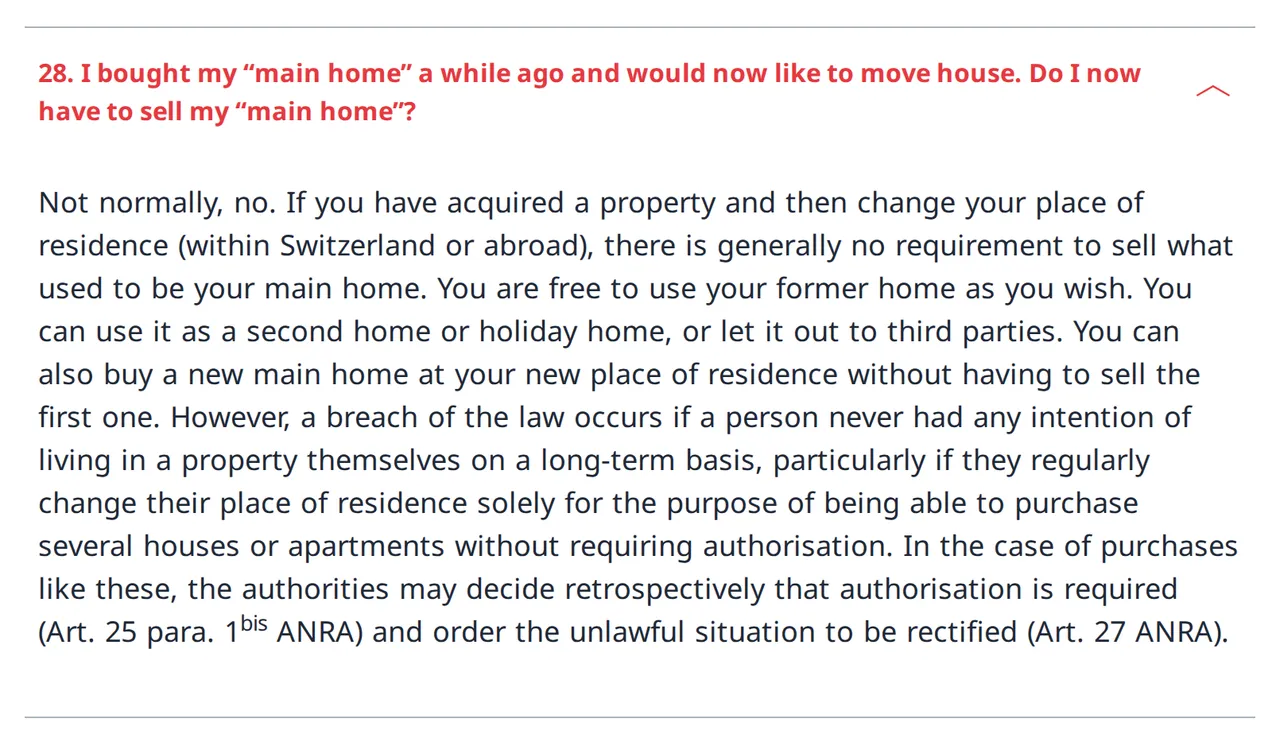
The limit is abuse. If you never intended to live in the home yourself for long, or if you only changed residence to buy several homes without authorisation, the authority can rule after the fact that authorisation was required. You then risk the purchase being reversed or the home being auctioned.
The Federal Council's preliminary draft (in German) turns this around. Third-country nationals without a C permit would need authorisation for a main home. It would be granted if the property is a single residential unit, but with a duty attached: if you stop using it as your main home, you have to sell it within two years. According to the explanatory report (in German), this applies if you move abroad, to another municipality and even to another home in the same municipality. The authority could not extend the two-year deadline.
So that nobody keeps a move quiet, residents' registration offices would have to report every departure and every change of address by a third-country national without a C permit to the cantonal authorisation authority. If you still do not sell after a reminder, the authority orders a sale or an auction. You would then get back only your acquisition costs, essentially what you paid and invested; any surplus would go to the canton. Wilfully ignoring the duty could mean a custodial sentence of up to three years or a monetary penalty.
Two points soften this. If you get a C permit while you are still living in the home yourself, the duty to sell falls away. And according to the report, if you bought your main home lawfully before the new law comes into force, you do not have to sell it when you move away later. The draft leaves the second homes of EU and EFTA cross-border commuters unchanged.
Cross-border commuters: a second home near work
If you are from an EU or EFTA country and work in Switzerland with a G permit, you can buy a second home in the region where you work without authorisation (Art. 7 let. j ANRA). The home has to make it easier for you to get to work, for example because you don't commute during the week.
The rules are much like those for a main home: in your own name, a single residential unit, no letting, not even in part. If the plot is over 1,000 square metres, the land registry office refers you to the authorisation authority. The law sets no distance limit for the "region", even though some guides quote one; whether the home makes your journey to work easier is for the authority to decide case by case. If you retire, according to the FOJ you generally do not have to sell.
For a holiday home or an investment, cross-border commuters still need authorisation. And if you are a cross-border commuter from a third country, this exception does not apply at all. You are treated like anyone else who lives abroad.
Living abroad: a holiday home only within the quota
If you live abroad, you can usually only buy a holiday home, and only with authorisation. According to the FOJ, 17 cantons recognise this ground for authorisation: Appenzell Ausserrhoden, Bern, Fribourg, Glarus, Graubünden, Jura, Lucerne, Neuchâtel, Nidwalden, Obwalden, St Gallen, Schaffhausen, Schwyz, Ticino, Uri, Vaud and Valais. In Nidwalden and Appenzell Ausserrhoden it covers only holiday homes, in Schaffhausen only units in aparthotels. Zurich, Geneva, Zug and Basel do not have it.
Even in these cantons it only works in places the canton has designated as tourist resorts, and municipalities can ban sales entirely or cap them with a quota. As a rule, the net living area may not exceed 200 square metres, or up to 250 in practice if you can show you need more. If the home is not part of a condominium, the plot is limited to 1,000 square metres, 1,500 in exceptional cases. Each family may own only one such home, counting spouses and children under 18 together. You buy in your own name, never through a company. You may let the holiday home from time to time, but not all year round.
Every authorisation counts against the canton's quota, which the Confederation sets each year. The national ceiling has been 1,500 units since 2007, and according to the explanatory report only about a third of it has been used since 2014. Things are tight mainly in Valais: it has 330 units and granted an average of around 334 authorisations a year from 2016 to 2025, including sales between foreign non-residents. When a foreign non-resident buys a home from another foreign non-resident, that does not count against the quota today.
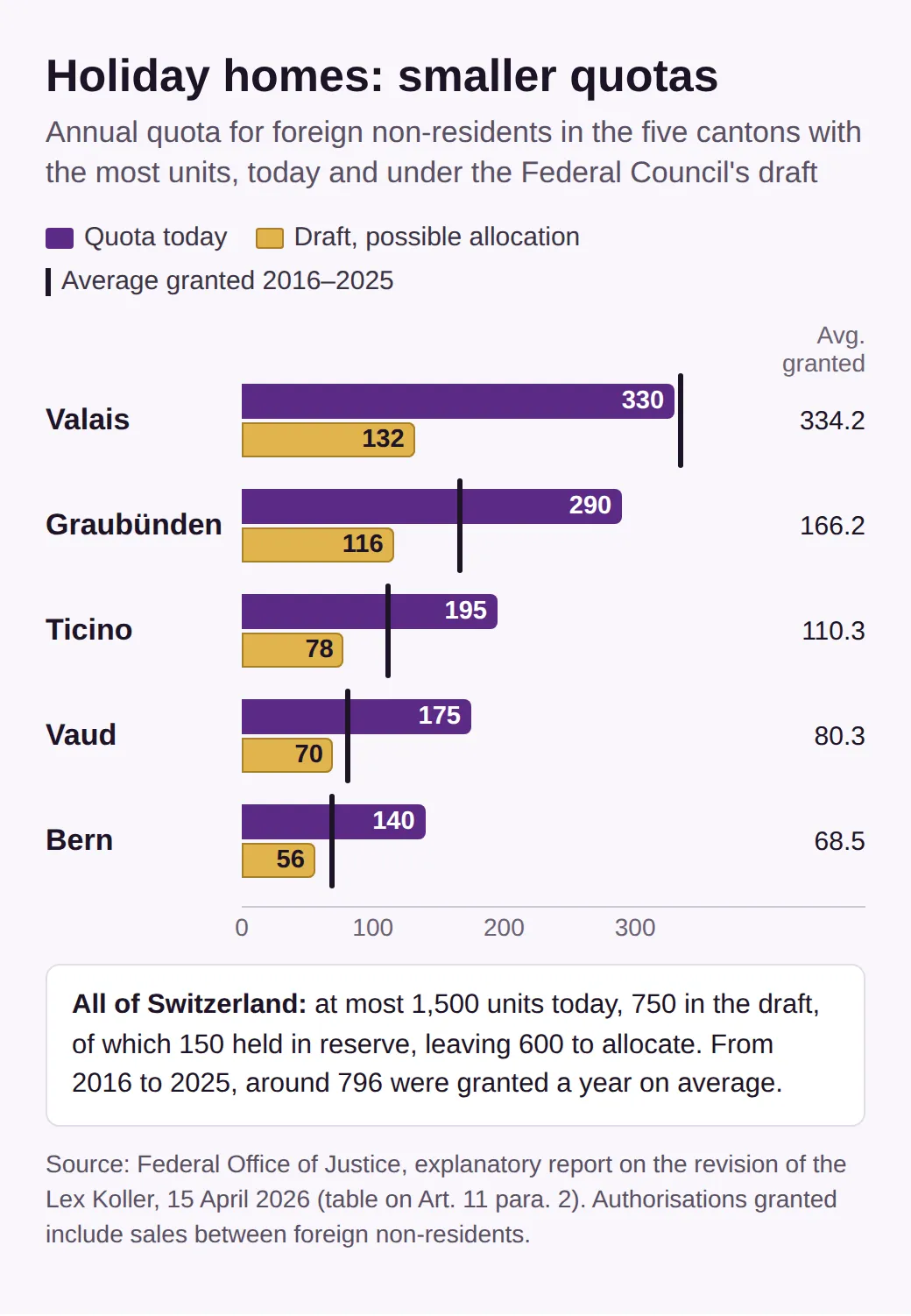
The draft halves the ceiling to 750 units. Of these, 150 would be reserved for cantons that do not currently recognise this ground for authorisation, so at most 600 would be allocated. Sales between foreign non-residents would count against the quota again. The FOJ roughly estimates that at least around 196 fewer holiday homes a year would go to foreign non-residents. Valais would be hit hardest, since it currently grants as many authorisations as its entire quota allows; in Graubünden and Ticino, too, the average so far would be above the new allocation.
Besides the holiday home, there is a narrow second route: a second home in a place with which you have "exceptionally close ties that are worthy of protection", for example for important professional or academic reasons. According to the FOJ, 14 cantons recognise this ground, including Zurich and Basel-Stadt. Relatives in Switzerland or regular holidays are not enough, and if you stop using the home in this way, you have to sell it within two years.
Investment, commercial property and building land
Buying an apartment or house as an investment is ruled out in principle for foreign non-residents, whether or not they live in Switzerland. That includes apartment buildings and building land you only want to hold: according to the FOJ, undeveloped land in a building zone generally needs authorisation, and leaving land unused for a long time counts as an unlawful investment.
Commercial property, on the other hand, is open today. Foreign non-residents can buy offices, shops, workshops and factory buildings without authorisation, even if they let the space to another company. Since 1997 that has also applied to a pure investment. The draft would reverse this: only buyers who use the property for their own business would stay exempt. If they gave up the business, they would have to sell within two years. Where a municipality requires homes on such sites, they could be bought along with the property without authorisation only up to a third of the gross floor area.
A third route today is shares in listed residential property companies and regularly traded units in real estate funds. Foreign non-residents can buy both freely. Under the draft they would need authorisation, which according to the explanatory report would in practice come close to a ban. Banks and other securities dealers would have to check such orders and refuse them if in doubt. Until then, though, every purchase goes through the same procedure.
What the cantonal office checks
The authorisation authority of the canton where the property is located is responsible, and each canton organises this differently. In Zurich the twelve district councils (Bezirksräte) decide, in Bern the Regierungsstatthalter, who head the administrative districts, and in Graubünden the land registry inspectorate. In Vaud it is the Commission foncière, in Ticino the Autorità cantonale di I. istanza LAFE. The addresses for every canton are in the FOJ's list.
The first filter is the land registry office. If it cannot readily rule out the need for authorisation, it suspends registration and gives you 30 days to obtain authorisation from the authority or a ruling that you do not need one (Art. 18 ANRA). With a B permit, the land registry office skips this detour if you show your permit, the plot is no more than 3,000 square metres and you declare in writing that you are buying it as your main home. Such a declaration could read like this:
I declare that I am acquiring plot no. [number] in [municipality] in my own name as my main home at my place of residence, that I will live in it myself with my family, and that I will not let it, either in whole or in part.
If your case lands with the authority, it looks especially closely at two things: whether you really live here and where the money comes from. In their information sheet (in German), the Zurich district councils ask for documents such as the purchase contract, your residence permit card, proof of financing with the names and nationalities of the lenders, and a declaration that you, your spouse and your minor children own no other property in Switzerland. A loan from a foreign non-resident that makes you heavily dependent on them counts as an acquisition in itself and can make the purchase subject to authorisation.
A decision only becomes final once the municipality, the canton's authority entitled to appeal and the FOJ waive their right to challenge it, or the 30-day deadline passes unused. The Zurich information sheet expects ownership to be transferred no sooner than about six to seven weeks after the decision is served. If the purchase needs authorisation, the contract has no effect until then. If the purchase is completed without the authorisation it needs, it is null and void, and doing so wilfully can mean up to three years in prison (Art. 26 and 28 ANRA). So have the purchase contract set out what happens if authorisation is not granted. For third-country nationals, how long the procedure stays like this is now up to Parliament.
What the Federal Council wants to change, and when
The Federal Council commissioned the tightening on 29 January 2025, as an accompanying measure to its rejection of the popular initiative "No to a Switzerland with 10 million! (Sustainability Initiative)". Its aim is to reserve more housing for the resident population. The consultation ran from 15 April to 15 July 2026; the responses from cantons, parties and associations are published on the FOJ's page on the revision (in German). In October 2026, Fedlex listed the proposal, consultation 2025/58, as closed and awaiting the results report. Voters and cantons rejected the initiative itself on 14 June 2026, with 54.8 percent voting no; that does not take the Lex Koller proposal off the table.
| What | Today | Under the draft |
|---|---|---|
| Main home, third-country national with B permit | allowed | authorisation, sale within two years of moving |
| Holiday homes, all of Switzerland | up to 1,500 a year | up to 750, of which 600 allocated |
| Commercial property to let | allowed | practically ruled out |
| Listed property shares and fund units | allowed | practically ruled out |
The next steps are the results report, then a dispatch to Parliament, debates in both chambers and a possible referendum, since the act is subject to an optional referendum. The Federal Council sets the date of entry into force, coordinated with a revision of the ordinance. According to the report, it plans to examine there, among other things, whether area limits should apply to main homes again, as they did before 1997: 200 square metres of net living area and, for houses, 1,000 square metres of land. Up to October 2026, the Confederation had given no date for any of this.
The outcome is not certain. A regulatory impact assessment commissioned by the FOJ concluded that tightening the rules would tend to worsen the problems on the housing market, especially for large projects; the Federal Council still considers the measures necessary. It had already put similar tightening out to consultation in 2017. Most respondents rejected it, the Federal Council dropped it in 2018, and in March 2022 the Council of States rejected a motion that sought to bring the proposal before Parliament after all.
One transitional rule is worth knowing if you happen to be buying when the change takes effect: the new law also applies to purchase contracts signed earlier but not yet completed in the land register.
What this means for your purchase
Check your own status first, not just your nationality. If you have an EU or EFTA passport and genuinely live here, or a C permit, nothing more in this article affects you, and you can focus on financing and the property: how much equity you need, whether you pass the affordability test and what buying costs your canton charges.
With a B permit from a third country, today's rule is: one apartment or house that you live in yourself, in your own name, without a granny flat and without letting. If you plan to buy anyway, you still buy under the old rules as long as the land register entry is made before any new law comes into force. But expect that you might have to sell the home if you move away in future, and ask your canton's migration office when you can apply for a C permit. With a C permit, every restriction falls away.
If you live abroad and are thinking about a holiday home, ask the municipality and the cantonal authority before you sign whether the place is open to foreign non-residents and how much of the quota is left. If in doubt, apply to the authorisation authority for a ruling that you do not need authorisation. It takes time, but less than a purchase that turns out to be void.
Common questions
Does buying property in Switzerland give you a residence permit?
No. The Federal Office of Justice states plainly that owning property in Switzerland does not entitle you to a residence permit. Permits are a matter for the State Secretariat for Migration and the cantonal migration office, whether or not you own a home.
My wife is Swiss. Do I still need authorisation to buy a house?
Yes, if you yourself count as a foreign non-resident. Your spouse's nationality does not change your status. If your wife buys alone and for herself, she needs no authorisation. But if she only buys on paper and is in fact buying on your behalf, that counts as evasion and is a criminal offence.
Can a foreigner living abroad inherit a house in Switzerland?
Statutory heirs under Swiss law need no authorisation to inherit. A foreign non-resident who inherits without being a statutory heir receives authorisation on condition that the property is sold again within two years. The authority can waive this if you show close ties to the property that are worthy of protection.
How long is a Lex Koller authorisation valid?
Three years. If the purchase is not completed in that time, the authorisation lapses. In exceptional cases the authority can extend the deadline if you submit a reasoned request before it runs out.
More from the blog
All posts
Condominium renovation fund in Switzerland: how much to pay?
Renovation fund in a Swiss condominium: recommended contributions, a worked example in francs, the rules, the owners' meeting and the 2029 tax change.
Reservation agreement in Switzerland: is your deposit lost?
Without a notary, a Swiss property reservation agreement is void. What the top court ruled on deposits, how to pay safely and the steps to the land register.
House viewing checklist: what to check in Switzerland
House viewing checklist for Switzerland: check for damp, the roof, heating, windows, asbestos and radon, ask for the right documents and bring an expert.