Property transfer tax in Switzerland by canton: 2026 costs

The short answer
According to the Swiss Federal Tax Administration (FTA, in German), property transfer tax is 1 to 3.3 percent of the purchase price, depending on the canton. Zurich has no such tax, only fees, and Aargau charges a land registry levy. For a CHF 1 million apartment with a new mortgage note, buying costs a total of around CHF 3,600 in Zurich, 7,900 in Bern as your main residence, 10,300 in Aargau and 41,000 in Lausanne.
Many guides give only a range and leave you to work out what applies in your canton. We read the laws and tariffs of four cantons, worked out the costs of the same apartment in each one and show who owes which part. The figures reflect the rules as of October 2026.
What you pay when you buy
When you buy, you pay three things: a tax or levy to the canton or municipality, a notary's fee for the contract and a land registry fee for the entry. If you buy with a mortgage, you usually pay the notary and the land registry a second time for the mortgage note (Schuldbrief), the document that gives the bank its lien on the property.
Whether a canton charges a tax or only a fee sounds like a lawyers' question, but it decides the amount. According to the FTA's dossier on the tax, a fee may at most cover the administration's costs, while a tax has no such limit. The FTA's overview of current taxes names eight cantons without a property transfer tax as such, which charge only transfer or land registry fees: Zurich, Uri, Schwyz, Glarus, Zug, Schaffhausen, Aargau and Ticino. All the others levy a tax, mostly between 1 and 3.3 percent. It is usually a cantonal tax; in Appenzell Ausserrhoden, St. Gallen and Graubünden the municipalities levy it, and in Fribourg, Vaud and Valais the municipalities may add a surcharge of their own.
The tax is the big item. In our examples the notary and the land registry cost a few thousand francs, while the tax can be many times that. Don't confuse these one-off costs with the running costs of the home that the bank includes when it checks affordability. What a purchase actually costs is clearest in a comparison.
The same apartment in four cantons
Our example is an apartment for CHF 1,000,000, financed with a mortgage of CHF 800,000, for which a new mortgage note of the same amount is created. The costs range from CHF 3,600 in Zurich to almost CHF 41,000 in Lausanne, more than eleven times as much.
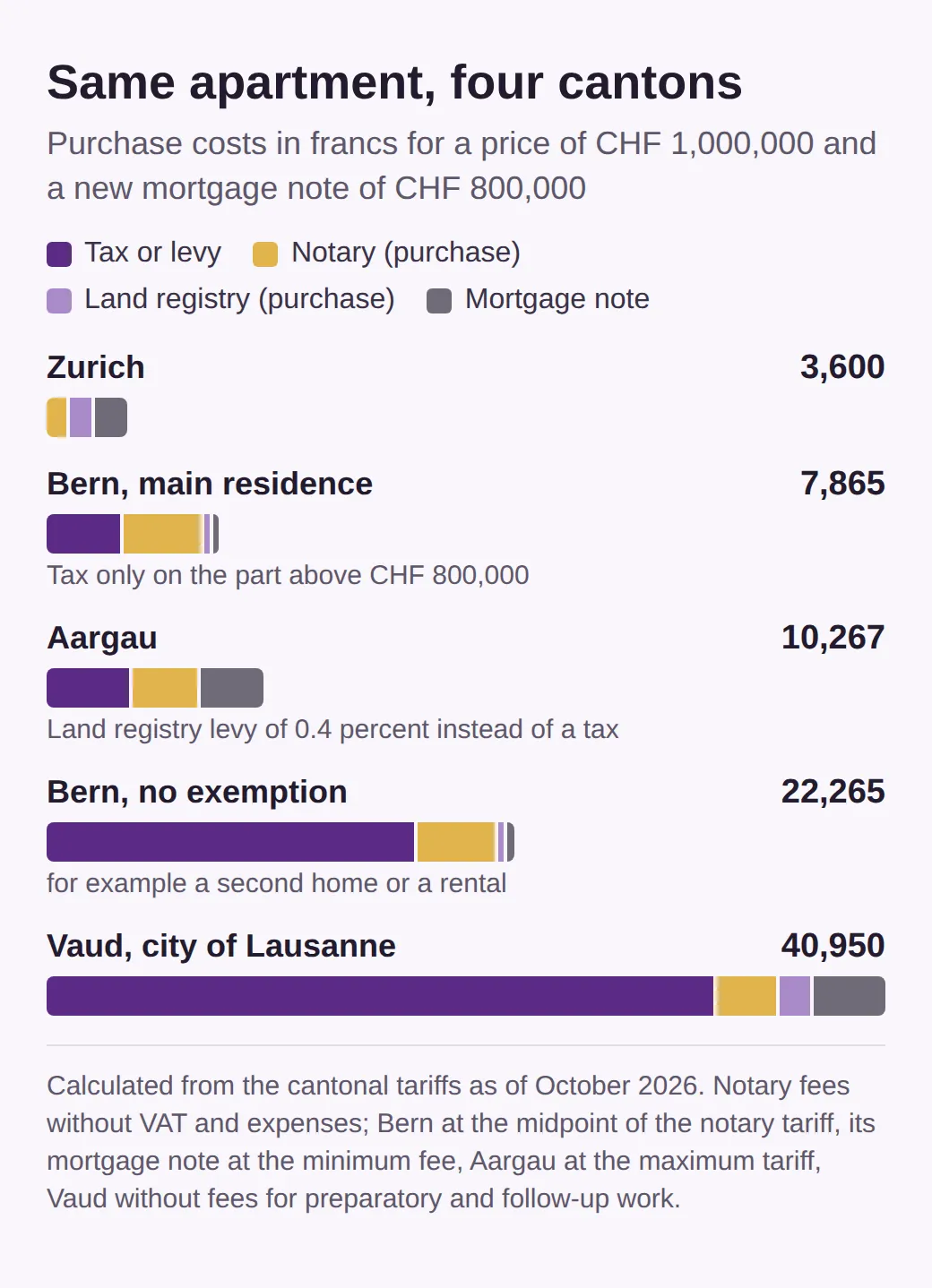
The figures follow the tariffs, with three assumptions where a tariff leaves room. In Bern we took the midpoint of the notary tariff, in Aargau the maximum, and in Vaud only the fixed part of the notary fee. VAT and expenses come on top everywhere. The totals show the cost of the whole transaction; who bears which part is covered further down.
| Canton | Tax or levy | Notary, purchase | Land registry, purchase |
|---|---|---|---|
| Zurich | none | 0.1 % | 0.1 % |
| Bern | 1.8 %, for a main residence only above 800,000 | fee range, at 1m: 2,915 to 4,575 | CHF 200 |
| Vaud | 2.2 % canton plus up to 1.1 % municipality | tiered, at 1m: 2,875 plus extra fees | 0.15 % |
| Aargau | 0.4 % land registry levy | at most 0.4 % up to 600,000, 0.2 % above | included in the levy |
The table shows the rules; the sections on each canton show the calculation behind them. We start with the cheapest.
Zurich: no tax, 0.1 percent each
The canton of Zurich has not levied a property transfer tax since 1 January 2005, as the canton's notaries' offices point out. What remains are two fees: 0.1 percent of the market value for the notarisation at the notary's office and 0.1 percent for the entry at the land registry office, each at least CHF 100. This is set out in the annex to the notary fees ordinance.
For our apartment that comes to CHF 1,000 plus 1,000. The mortgage note of CHF 800,000 follows the same pattern: CHF 800 for the notarisation and 800 for the land registry. VAT is added to the notarisation, while the land registry fee is exempt; the notaries' fee calculator shows the two separately. The rate is fixed in the tariff, so there is no room to negotiate the price.
Zurich sets out in law how the notary and land registry costs are split. Under § 29 of the Notaries Act, the buyer and the seller owe the fees for a change of ownership in equal parts. The contract may still say otherwise. For the mortgage note, the law's basic rule applies: whoever asks for it pays, which is usually the buyer.
Bern: 1.8 percent, but not on the first CHF 800,000
Bern levies a genuine tax of 1.8 percent on the price, and the buyer owes it. This is set out in Articles 2 and 11 of the Property Transfer Tax Act (Handänderungssteuergesetz). Since 2015, though, there has been a big exception: if you use the house or apartment as your main residence, you end up paying no tax on the first CHF 800,000.
The exemption isn't automatic, and it only comes afterwards. The request is filed with the land registry application, so tell your notary early. The land registry office then assesses the tax on the full price, collects the part above CHF 800,000 straight away and defers the rest. For the deferred amount it registers a statutory lien on your property.
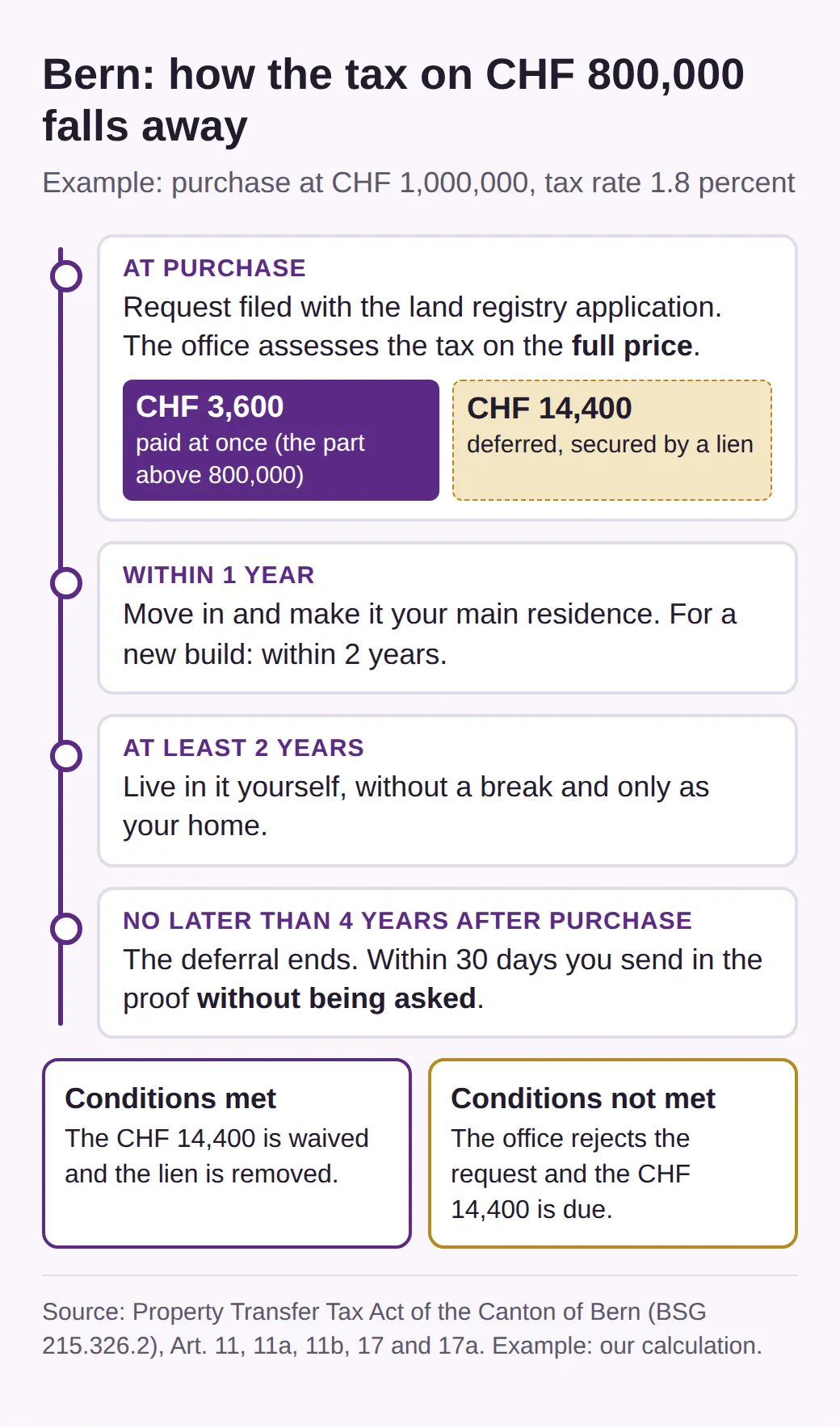
The conditions are strict. You must move in within one year of the purchase, or within two years for a new build. After that you must live there for at least two years without a break, yourself and as your only home. The deferral runs for at most four years from the purchase, and within 30 days of its end you must send in the proof without being asked. If the conditions are not met, for example because you move out earlier and rent the place out, the office rejects the request and the deferred amount becomes due.
For our apartment that means CHF 3,600 at the purchase, with 14,400 deferred and waived at the end. Without the exemption, for instance for a holiday home or an apartment you rent out, it would be CHF 18,000.
In Bern you pay the notary according to a fee range set in the ordinance on notary fees. For a purchase contract of CHF 1 million, the fee is between 2,915 and 4,575 francs, with a midpoint of 3,745. Where it lands within that range depends on the work involved, the importance of the deal and the notary's responsibility, and VAT is not included. For the mortgage note the notary charges by the hour, at a rate between CHF 250 and 400 and at least CHF 200. The land registry office itself is cheap: CHF 200 to enter the new owner, 20 for each additional person and 120 for the lien, according to the tariff in the fees ordinance.
Vaud: the most expensive canton in our comparison
Vaud levies a property transfer tax of 2.2 percent, the droit de mutation. The municipality may add up to 50 centimes for each franc of cantonal tax, another 1.1 percent. According to the Vaud cantonal tax administration (in French), a total of 3.3 percent is usual. Lausanne charges the maximum: the city's tax decree for 2025 to 2029 sets it at 50 centimes per franc.
For our apartment that is CHF 22,000 for the canton and 11,000 for the city. The tax is calculated on the gross value of the property, and debts secured on it are not deducted. The buyer and the seller are jointly liable to the state; unless they have agreed otherwise, the buyer bears the tax. The parties must deposit the tax, including the municipal share, with a public officer such as the notary or with an approved body.
In Vaud the notary charges a fixed base fee under a tiered tariff: 0.7 percent on the first CHF 100,000, then falling, down to 0.15 percent between CHF 750,000 and 2.5 million. At CHF 1 million that comes to CHF 2,875. There are also fees for the work before and after the signing, which depend on the importance and difficulty of the deal and are not in our calculation. The mortgage note of CHF 800,000 adds a base fee of CHF 2,375. Under the land registry act (loi sur le registre foncier), the land registry charges 0.15 percent each for the change of ownership and for the lien, here CHF 1,500 and 1,200.
Unlike Bern, Vaud has no relief for buying your own main residence. According to the tax administration, the list of exemptions is exhaustive. It names the Confederation, the canton, the municipalities, non-profit institutions and transfers between spouses, but no case for buyers who move in themselves.
Aargau: a levy that sounds like a fee
Aargau has no property transfer tax but a land registry levy of 0.4 percent of the purchase price, at least CHF 100. The FTA calls it a hybrid of fee and tax. It is based on the land registry charges act; if the property's tax value is higher than the purchase price, the tax value applies.
For our apartment that is CHF 4,000, plus another 0.15 percent for the mortgage note, so CHF 1,200. The law does not say who pays, only that both parties are jointly liable. The land registry office can therefore turn to either of them; who bears the levy in the end is set out in the purchase contract.
For the notary, Aargau sets maximum prices, not fixed ones. The decree on the notary tariff allows 0.4 percent up to CHF 600,000 and 0.2 percent on the part above, capped at CHF 20,000. At CHF 1 million that is CHF 3,200. For the mortgage note, two thirds of these rates apply, calculated on the secured amount and capped at CHF 7,500, in our case 1,867. The notarisation act expressly allows notaries to charge less. In Aargau it pays to compare two or three quotes.
Who pays property transfer tax, buyer or seller?
In most cantons the buyer pays, unless the contract says otherwise. That is how the FTA sums it up. Only in Obwalden, Basel-Landschaft and Appenzell Ausserrhoden do buyer and seller normally split the tax equally.
What the contract says matters more than the rule. In Vaud and Aargau both parties are jointly liable, which means the canton can claim the full amount from either of them. An agreement in the purchase contract only settles who owes what to whom in the end. So read the draft carefully before you go to the notary, and check three points: who bears the tax or levy, how the notary and land registry costs are split, and who pays for the mortgage note.
One tax concerns only the seller: the property gains tax on the seller's profit. It is not part of your buying costs, but it can still affect you. The notaries' offices in the canton of Zurich state that the property is liable for this tax. That is why, according to the notaries' offices, it is secured in most cases; the purchase contract should set out how.
The mortgage note: fees only for a new lien
Many people overlook the mortgage note because it is not in the purchase contract. In our calculation it costs between just over CHF 300 in Bern and 3,575 in Vaud. In all three cantons with a percentage tariff, the fee is charged when a lien is created or increased.
That opens up a way to save. If the seller already has mortgage notes on the property, your bank can take them over instead of having new ones created. You then pay the percentage fee only on any increase, plus small fixed fees for the change of creditor. Whether the bank does this is its own decision; ask early, ideally when you get the financing offer. Which term and which model you choose for the mortgage is a separate question, which we work through in SARON or fixed-rate mortgage.
How the costs change with the price
The more expensive the property, the further the cantons drift apart. At CHF 500,000, Zurich, Aargau and Bern as your main residence are all still below CHF 5,000. At 2 million it is CHF 4,000 in Zurich and around 73,000 in Lausanne.
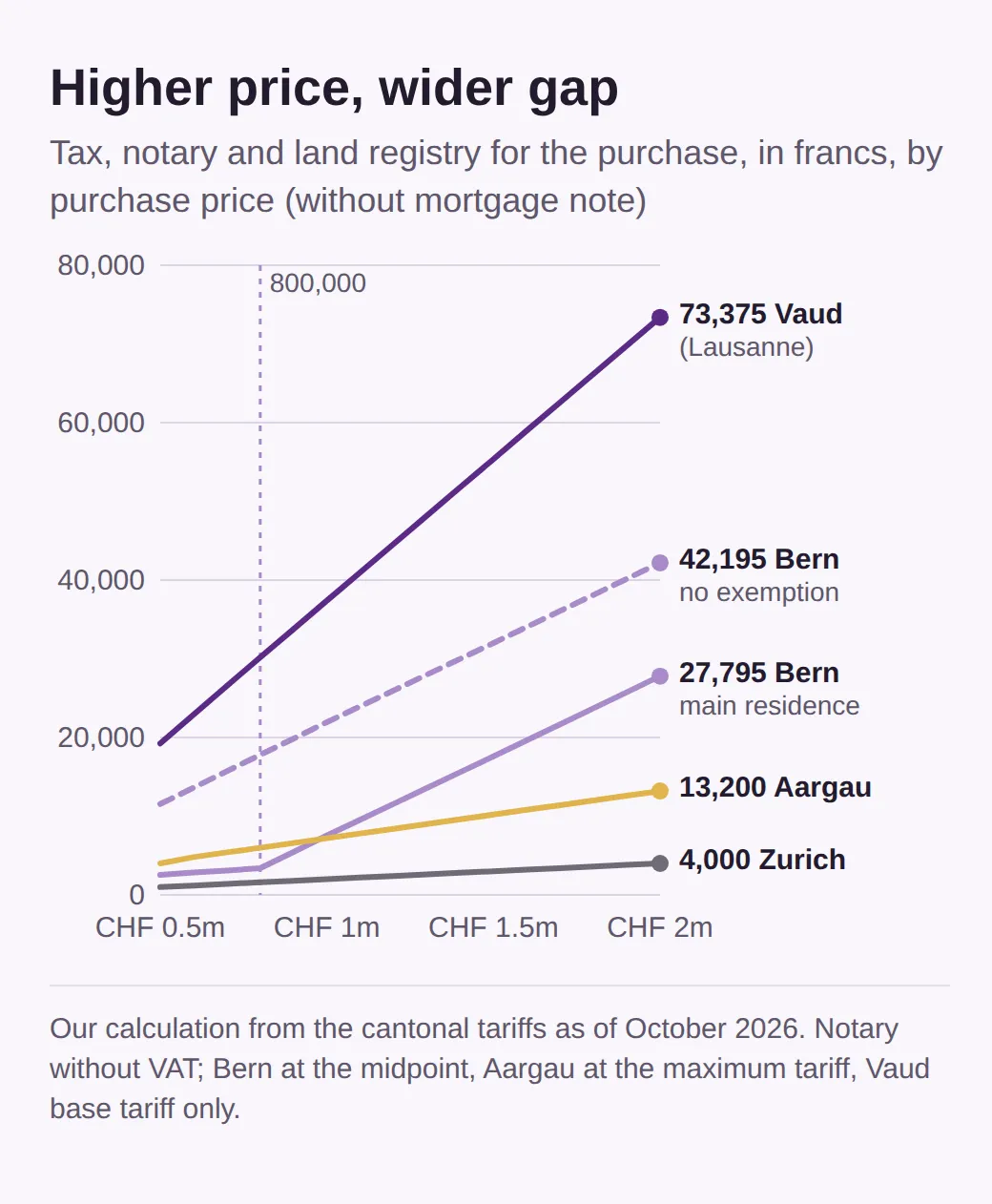
The kink in the Bern line stands out. Up to CHF 800,000, if you move in yourself, you pay only the notary and the land registry. Above that, the line climbs at 1.8 percent just as steeply as without the exemption, only 14,400 francs lower. So the exemption is a fixed amount, not a percentage: on a house for CHF 2 million it saves exactly as much as on one for 900,000.
Before you sign the purchase contract
Work out the buying costs for your canton and your price before you negotiate, not afterwards. Ask the notary for a cost estimate with every item, including VAT and the mortgage note. You pay these costs on top of the equity the bank requires for the purchase price; our article on equity for buying a home explains how much that is.
Check in the draft contract who bears the tax and the notary and land registry fees. If you are buying in Bern to live in yourself, make sure the request for the deferred exemption is filed with the land registry application, and put the deadline for the proof in your calendar right after the purchase. In Aargau, get two quotes from notaries. And if your bank can take over existing mortgage notes, you save most of the mortgage note costs in our CHF 800,000 example: around CHF 3,500 in Vaud and around 3,000 in Aargau.
Common questions
Do you pay property transfer tax on a gift or inheritance in Switzerland?
Each canton decides for itself. Bern charges no tax on an inheritance, on a gift or when property passes to a spouse, a registered partner or descendants. Vaud exempts transfers between spouses and registered partners. In other cantons, ask the land registry office before you transfer a property within the family.
Is property transfer tax charged on the building costs of a new build?
In Bern it is if you buy a turnkey building, or if the purchase contract is tied to a construction contract with the seller or someone close to the seller. The tax is then due on the total price of land and building work. If you buy only the land and choose your builder freely, you pay the tax on the land price. For other cantons, check with the land registry office before you sign.
What happens if the seller does not pay the property gains tax?
The seller owes the tax, but according to the notaries' offices in the canton of Zurich the property itself is liable for it. If the seller does not pay, the state can recover the tax from your new property. That is why, according to the notaries' offices, the tax is usually secured; the purchase contract sets out how.
Do you pay VAT on notary fees in Switzerland?
Usually, yes. In Bern VAT is not included in the notary tariff, and in Aargau the notary charges it on top. In Zurich the notarisation is subject to VAT, but the land registry fee is not.
More from the blog
All posts
Reservation agreement in Switzerland: is your deposit lost?
Without a notary, a Swiss property reservation agreement is void. What the top court ruled on deposits, how to pay safely and the steps to the land register.
SARON vs fixed-rate mortgage 2026: rates, margins, risks
SARON or fixed-rate mortgage in Switzerland, autumn 2026: SNB rate 0%, SARON just below zero, average rates, bank margins and when fixing pays off.

Equity to buy a house in Switzerland 2026: rules and costs
20% equity, at least 10% from outside your pension fund: what banks accept, how withdrawing or pledging works and how much tax a withdrawal costs by canton.